
The A stands for asexual: Explaining the often forgotten group
Harris Turner, Contributor
When you think about LGBT, what comes to mind?
Gay? Lesbian? Perhaps transgender, two-spirited, or intersex people.
Acronyms referring to the queer community have evolved over the years. Until 2022, the Government of Canada used LGBTQ2, and for the last three years, it has recognised 2SLGBTQI+ as its official abbreviation.
Yet there is one letter that is often forgotten—so much so that it’s left out of many acronyms altogether: asexual.
Save for the lesser-used abbreviation, 2SLGBTQQIA+, which was included in the 2021 report, titled the National Inquiry into Missing and Murdered Indigenous Women and Girls, asexuality is rarely remembered in synthesised terms.
In many ways, being asexual is the ‘invisible’ sexuality in which others won’t know until they truly get to know a person. It’s not a visible minority in the same way that a racialised person is, and asexuals do not have the same amount of documented history as gay or lesbian people.
Further still, there’s no clear asexual ‘look’ or identifier, often because it overlaps with other aspects of the queer community. But one thing is for certain: it has nothing to do with hormonal levels, at least for most people.
Starting at the top: Defining the queer alphabet’s A
Asexuality is when a person feels no attraction or has little drive for sexual acts. This is the typical idea of what one thinks when thinking about asexuality, despite this being rather rare in practice.
This is, of course, surface-level, like how an asexual feels about sex itself, and there are many more types of asexuality and factors to consider.
At its core, asexuals—or “aces”—feel little to no sexual attraction to anyone. “Aros,” or arosexuals, are considered the opposite, and are defined as those who do feel sexual attraction, but little romantic attraction.
However, both exist on a personal spectrum, and both can find attraction in different ways aside from the sexual, such as aesthetically, emotionally, personally, and even platonically.
There are also various branches or subcategories under the “ace umbrella,” including grey and demi sexual. Greysexuals have limited amounts of sexual attraction towards others. There are sometimes, but not always, situations in which attraction varies greatly and infrequently, as it is closer to a wide range of feelings than to true absolutes.
Demisexuals feel attraction only to people they have spent a long time with and have formed an emotional bond with. For them, attraction is often very hard to develop until they really get to know someone on a personal level.
From the past to the present
According to It Gets Better Canada, asexuals make up approximately one per cent of the world’s population, which sounds small, but accounts for an estimated tens of millions of people. However, because of the inconsistent collection of the sexual orientation statistics, the exact number is unknown today.
Throughout their ever-present history, members of the queer community have been criminalised and stigmatised, leading to the archives documenting their existence being hidden or distorted until efforts bringing these to light happened in recent years.
Before sexual orientation was included in the Canadian Charter and Rights and Freedoms in 1995, and later added to the country’s Human Rights Act with the passing of Bill C-33 the following year, asexuality was considered a psychiatric disorder.
Since the country’s establishment, the Census of Canada has been responsible for collecting population data every five years. However, the soon-to-happen 2026 census will be the first to ask residents to define their sexual orientation, by way of marking lesbian, gay, bisexual, or another sexuality that is not heterosexual.
This new update brings to light how all queer people have gone unaccounted for in national data, and that even today, asexuals are subject to being mislabelled or lumped together with other identities, despite their long-known presence.
According to the Society of Alberta Asexuals and Aromantics, asexuals have been known since Ancient Rome. The initial term “nonsexual” was one of the first interchangeable identifiers that went as far back as the 1890s to describe those who felt no attraction, along with “asexual.”
Over the 1970s, this term became much more concrete with texts like Lisa Orlando’s Asexual Manifesto. The two decades to follow saw a larger push towards the identifier, and by 2001, asexuality had its own online community with the Asexual Visibility and Education Network.
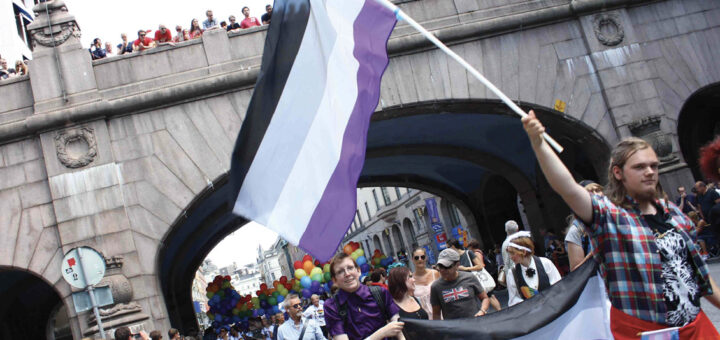
However, it wasn’t until 2010 that they had their own flag—a very recent development compared to the original pride flag, which was created by activist Harvey Milk and artist Gilbert Baker in 1978.
Where education meets understanding
Feeling isolated is common not only for those who are heterosexual but also for those across the queer community. After all, in a world that is driven by sex and intimacy, it can be hard for asexual people, especially romantically, to find connections.
There’s a fear that perhaps even if they found a partner, they would leave because of who they are. Some asexual people may not feel like they are a part of the queer community at all because their differences are too great.
There has even been discrimination, while not as prominent as others within queer circles, especially because not many lack the understanding or knowledge of what being ace means. The same struggle has happened for those who are lesbian, gay, trans, bisexual, and so much more of the queer community.
Emily Coutts, who was an active asexual online during the 2010s, said that even then there was discourse on what being asexual is—who fits and who does not.
There have been pushes to “disprove” aces like those before it as merely a choice, a hormonal imbalance or “just not finding the right person” from both people outside and, unfortunately, within the queer community itself. Asexuality, at times, is seen as an “impossibility”—how can someone not feel anything for their preferred sex?
Thankfully, this is decreasing, especially in the last couple of years. With proper education, resources and representation in various media, there is a much larger understanding of what it means to be asexual. It certainly is not perfect, but it’s given a chance for others to walk in an ace’s shoes.
For those who are friends with an asexual, it’s crucial to show them unjudgmental acceptance. Outside of sexuality, asexual people aren’t much different, with their own backgrounds, communities, and interests.
Teaching oneself about what it means to be ace can shine an entirely different light on the subject. It doesn’t need to be academic—it could be as simple as playing a game made by an ace person, engaging with a YouTube video, or even watching a movie. By reaching the end of this article, you are already doing this.
Asexual people, like other marginalised groups, deserve respect and patience. They don’t need help or to be fixed, but they will certainly enjoy it if you bake them a cake.