OPINION: Explaining the weirdly wonderful world of parliament
Ryan Montgomery, Staff Writer
Parliament can be rather stuffy. It can seem like an archaic institution full of inane traditions.
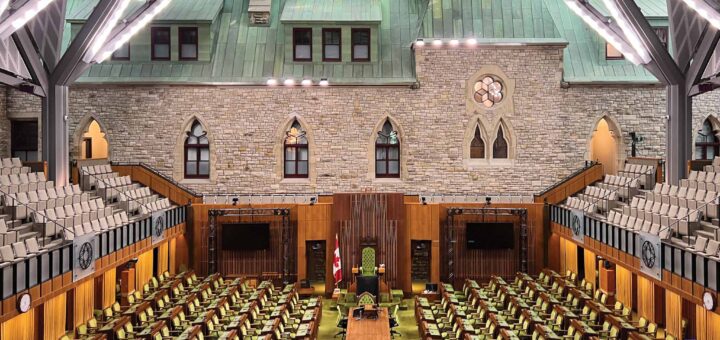
However, do not let the old mahogany walls and antique green leather chairs deceive you, because parliament has a history that’s as bloody as a butcher’s cleaver, and significantly less efficient.
The distance between the government and opposition benches, exactly 3.96 metres apart, was decided centuries ago to be just beyond the length of two swords. This was so that, back in the day, when gentlemen had sabres and the like, the honourable members couldn’t stab each other from where they sat—something I’m sure today’s Liberals and Conservatives lament daily.
Weapons are at the very core of the parliamentary process. If you have ever watched a parliamentary debate, the eagle-eyed among you would have noticed a massive golden mace in the middle of the central table.
This mace represents the power of the King and the power of the speaker to control the House of Commons. I trust the threatening symbolism of a huge weapon representing the King and his authority sitting in the middle of parliament isn’t lost on anyone.
However, we live in a more enlightened time, away from the executioner’s axe of Henry VIII, away from the spectre of civil war between the house and the king. Our bruised arms are now strung up for monuments, as Shakespeare said.
Today, it is a different age: the many fleeting fights of our democratic representatives are now settled with battles of words rather than wars of weapons. And boy, is it annoying.
Canada’s parliamentary rules for dummies
Jeering, name-calling, bickering, and petty, argumentative squabbles are the order of the day in our democracy. So who is to keep order in the schoolyard?
The speaker, of course, has many tools at their disposal—the most prominent among these is control over what is called ‘unparliamentary language.’ This is language deemed unacceptable to use whilst parliament is in session. There are numerous types of speech that meet the threshold of unparliamentary behaviour, the most obvious of which is swearing or foul language.
Regulating this has caused many aspiring parliamentary poets to come up with new and novel ways to say mean things about their coworkers. The most iconic of these was in 1971, when the former prime minister, Pierre Trudeau, mouthed two decidedly unparliamentary words starting with “f” and “y” at the Conservatives across the bench. When later questioned, he claimed that he mouthed the words “fuddle duddle” at the opposition, but I’ll leave it to the reader to infer what he actually said.
Across the 800 or so years of Westminster parliamentary government, there have been some real gems of unparliamentary words flung across the aisle. Some of my favourites from across the Commonwealth are as follows.
One inscnesed New Zealand MP once declared of his political opponent, “his brains could revolve inside a peanut shell for a thousand years without touching the sides.”
Some of the highlights from the United Kingdom are predictably old-fashioned and quaint, numbers like “hooligan,” “guttersnipe,” “pipsqueak,” and my personal favourite, “wart.” It is the job of the speaker of the house to ensure that no honourable member ever utters such abhorrent words as these.
These rules extend to even that most ubiquitous of a politician’s pastimes: lying. MPs are strictly forbidden from accusing fellow members of lying. This is because the language of the politicians must uphold the honour of the house and its members, so any attack on another member’s honour is strictly forbidden.
This has led the honourable members to search for all manner of synonyms and euphemisms. The most notable of these was coined by none other than Winston Churchill himself. The young Winston accused an opposing member of uttering a “terminological inexactitude,” which surely must be the most eloquent ‘nuh uh’ in the history of the English language.
If an MP utters a statement deemed by the speaker to be unparliamentary, then they will be formally asked to retract that statement. If the honourable member declines to do so, invoking the parliamentarian version of a ‘no take-backsies,’ then they will be removed from the chamber. This happened in April 2024 when the leader of the Conservative Party, Pierre Poilievre, called former prime minister Justin Trudeau a “wacko.”
Trudeau himself once had a run-in with the metaphorical unparliamentary language police when, in 2011, a then-backbencher Trudeau sporting a supervillain goatee called a fellow member a “piece of shit.” Trudeau, however, apologised immediately for this outburst and was allowed to remain in the house. Personally, I think Trudeau got more value out of his dollar in the swear jar.
Another statement that is considered unparliamentary is the insinuation or accusation that your opponent is drunk or intoxicated. Prime minister from 1867 to 1873, Sir John A. Macdonald, a notorious boozer, got a lot of mileage out of that one.
In one incident, while in the middle of a debate, he suddenly retched all over the debate stage. Upon coming to his senses, Macdonald said to the crowd, “forgive me, but whenever my opponent speaks, I lose my stomach.”
Britain’s parliament, always keen to find the next frontier of articulate insults, invented the euphemism “tired and emotional” to describe a member of parliament who was clearly out a little too late last night. Innovation really is a beautiful thing.
Parliament is a peculiar place, a mix of antiquated rules, absurd traditions, and interior decor full of implicit threats. Despite all these curiosities, or perhaps in a small way because of them, is why I see the political system as one of the most stable in human history. So if there’s any moral to this story of swords, swears, goatees and gagging, maybe it’s that if it ain’t broke, don’t fix it.