
Digging out of the hole: Why Alberta’s gopher museum is struggling to stay afloat
Nadoo Abaagu & Amy Jaquish, Staff Writers
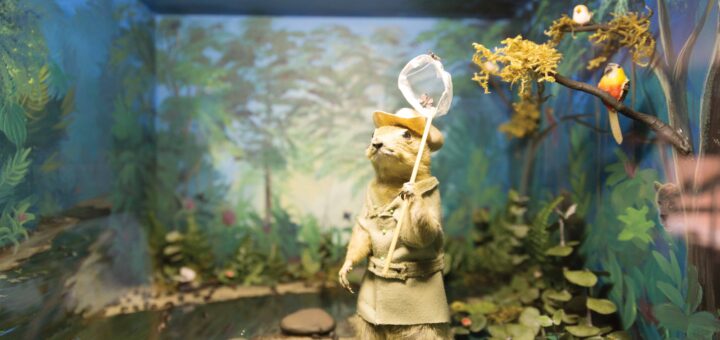
The World Famous Gopher Hole Museum, a beloved historic centre in Torrington, Alta., is relocating for reasons that raise alarms about the struggles faced by small-town attractions province-wide.
Laural Kurta, the museum’s director, says that a maple bug and wasp infestation accelerated the decision to close the building, which was already struggling after 30 years of operation.“The building has twisted, there’s wood rot, and the wood rot has brought in maple bugs,” says Kurta.
Additionally, she says there is also water damage and insulation problems with the buildings. Kurta says the museum has made calls about a new building since last year, but that there is nothing to rent in Torrington.
“We have had lots of buildings offered to us, but it’s people who are building new homes on their existing old farmhouses. So they’re old farmhouses or older mobile homes, and then we’re running into the same problems that we have now, ” says Kurta.
The museum relies on donations and has been financially self-sufficient since opening. But with the added cost of the building’s deterioration, Kurta says they are actively pursuing grant applications.
Kurta says that obtaining grant funding is harder for small-town museums, which, unlike bigger institutions, do not have professional grant writers.
One of the organizations that provides funding to museums is the Alberta Museums Association (AMA), which, in a 2024 budget report, noted that due to budget stagnation, it is struggling to support local museums.
“The AMA continues to operate on a reduced funding envelope, putting continued strain on the programs and services that are offered to the diverse community of museums and museum professionals that we support,” read the report.
However, grants and bursaries are not the only way the AMA supports museums, as CEO Jennifer Forsyth says that they also offer training workshops, networking opportunities, and other resources.
“Small-town museums are the backbone of Alberta’s heritage sector,” she says. “Many rural museums rely on volunteers, and we offer tools, mentorship, and community-building supports that meet their capacity.”
According to the Alberta Museums Project, the Gopher Hole Museum is not the only one struggling to stay afloat, as many of the province’s 314 museums are also located in rural areas.
The Sundre & District Museum says it was almost forced to close for half of 2025 because of a lack of funding. Executive director Carrie Couch says that if it weren’t for a handful of donations, their doors could have closed.
“We were going to close, but the town stepped in and offered an operational lifeline to keep us open,” she says. “In December, we received two donations that have enabled us to keep our doors open for the public, retain our staff persons and our very important volunteers.”
With eight historical buildings sitting on four acres of land, the Sundre museum depicts Sundre’s pioneer life. It also manages 170 taxidermied animals in its wildlife exhibit.
Though it is a much bigger operation than the Gopher Hole Museum, it is also primarily supported by donations and grants. But because there are many museums vying for the same funding, Sundre says it’s slim pickings.
One of the grants offered by the AMA is called the Operational Staffing Grant, which provides one-year funding assistance for wages or salaries of core staff positions. In 2024, they said this grant made up 81 per cent of the grants they gave out.
However, the struggle to secure grant funding is not limited to Alberta but also at the national level.
Not just a provincial problem
In a November 2025 letter to François-Philippe Champagne, minister of finance and national revenue, the Canadian Museum Association expressed its concern about federal budget decisions.
“The federal budget has abandoned Canada’s museums. Budget 2025 delivers virtually nothing, no cohesive vision for Canada’s 2,700 museums—institutions present in every riding that preserve heritage, educate communities, drive tourism, and employ over 32,000 Canadians,” read the letter.
A 2020 Statistics Canada report found that museums in Alberta employed 826 full-time employees, 1,372 part-time employees, and 5,531 volunteers.
In part, Forsyth explains that these two challenges work together to create an uphill battle for museums in Alberta.
“Sustainable funding and staffing capacity are ongoing challenges. Many museums operate with small teams or volunteers while balancing rising costs, aging infrastructure, collection care, and evolving public expectations,” she says. “Maintaining long-term financial stability while staying relevant to diverse communities is a major pressure point.”
Staffing poses a challenge for both the Gopher Hole Museum and the Sundre & District Museum, as they rely on small pools of volunteers that are often insufficient to meet the required workload.
“Staff and volunteer burnout is an issue—the job required and the many hats we wear is amazing, and the stress we carry, especially because we are the gatekeepers of local history, is immense,” says Couch.
Local directors find the work is worth it
Kurta says that running the Gopher Hole Museum is hard work, but worthwhile. She says it is a family business of sorts, since her parents helped build the attraction and remained steadfast stewards of the museum.
When she was younger, Kurta resented the time and energy her parents invested in the museum, but after five years as the museum’s director, she has come to appreciate the museum’s ability to bring people together.
“People just start talking because they’re laughing, and those conversations are really transformative,” says Kurta. “I really appreciate that. I’ve seen stories in there that deeply touched my heart, and I didn’t realize that could come from a Gopher Hole Museum, but it does, and it happens all the time.”
In 2026, the Gopher Hole Museum will be making some adjustments to stay open. A new location has not been decided on, but Kurta hopes to start sponsoring the Gopher boxes to private companies to help with funding the museum. She says she will do everything in her power to help it live on.
“It really affects people deeply, and I can’t explain that. I don’t know why it touches people the way it does,” says Kurta. “The fact is, it does, and that’s important to me. For that reason, I’m going to make sure that it stays around.”
The Reflector regrets to inform you that factual errors were made regarding the World Famous Gopher Hole Museum’s funding model and reason for closure in the March 6, 2026, version of this article. As of March 10, 2026, certain facts and attributions have been corrected. We apologise for the error.