
The cheapest seat in motorsport might be at the desk
Mustafa Imran, Contributor
The world of sim racing has become a genuine pathway into top-level motorsports within the past 15 years. Many automotive manufacturers have funded it through different disciplines, such as endurance racing, GT3 and sportscars.
Sim racing has received its fair share of public support and criticism. Some argue that it is cost-effective and offers more opportunities, while others argue that it’s “only a game” and that the skills are not transferable to top-level motorsports.
From the desk to the driver’s seat
Senior figures in motorsport, such as Lewis Hamilton and Toto Wolff, have criticised the cost of entry-level motorsport and backed sim racing for its affordability.
The starter kit for sim racing is simple. Racers need a playing platform—either PC or console, the racing game of their choosing and a basic controller set-up consisting of a steering wheel and pedal set.
Advanced racers also use a profiled chassis or racing body to sit in. A basic sim racing setup starts at only a few thousand dollars. Real-world motorsport is far more expensive.
In a report by Speedcafe, the cost to compete in a karting league starts at $250,000 per season. A seat in Formula 4 is $500,000, while drivers in Formula 3 must pay a minimum of $1 million.
Four-time Formula One (F1) World Driver Champion Max Verstappen is trying to make sim racing a real pathway into professional motorsport. Verstappen created a GT3 driver development program, which grew from the talent from his sim racing team, Team Redline.
Verstappen said he wants it to be a stepping stone into the world of professional motorsports, allowing drivers to bypass the expenses of karting and lower-level formula leagues.
The first graduate of Team Redline was Chris Lulham. In 2021, he joined Verstappen’s Team Redline; in 2025, he switched to the GT3 team and went on to win a race at Germany’s Nürburgring Nordschleife alongside Verstappen.
Verstappen has not been the only figure to provide racers with an alternative option. GT Academy, a Nissan-funded program, has developed drivers from sim racing into various forms of motorsports. Lucas Ordóñez and Jann Mardenborough have been two big successes from the GT Academy program.
Ordóñez won the first GT Academy back in 2008, while Mardenborough followed suit in 2011. Throughout his career, Ordóñez finished second in his class at the 24 Hours of Le Man in 2011. Mardenborough also competed in the coveted 24-hour race, with his best finish being third in his class.
The International Motor Sports Association (IMSA) has also launched a sim racing program in 2022 called the IMSA Esports Global Championship. The league features its own multi-class racing, featuring races every second Sunday from September to November. When it was launched, it was pitched as a way for drivers to build relationships with teams and grow their skills. It is not a guarantee that the driver will make the switch.
Joshua Rogers had built his relationship with Porsche through this series. He debuted in the 2025 IMSA Esports series. That later became a seat in the 2026 Porsche Sprint Challenge GB, where he scored three podium finishes.
Formula 2 (F2) is no stranger to sim racing. Back in 2017, Turkish driver Cem Bölükbaşı raced in the official Formula One esports series—a professional video game competition sponsored by F1. In 2022, he became the first driver from the series to race in Formula 2.
“I would not be where I am now,” said Bölükbaşi in an interview with One Esport.
Those who support sim racing as a way to compete professionally in motorsport argue that the skills they develop carry over to the car because modern simulators use laser-scanned tracks and realistic physics.
Drivers are also equipped with knowledge of the circuits, racing lines and the ability to read data before they ever set foot into a team’s garage.
Not so fast
Over the years, many sim racing programs have disappeared, like the GT Academy. The program initially worked for drivers like Ordóñez and Mardenborough due to it bridging the economic gap in the world of motorsports. But after numerous setbacks such as GT Academy winners being banned from the Pro-Am category, it was shut down.
Racing sims fail to recreate the G-forces drivers will experience in a car. Drivers, like GT Academy alum Mardenborough, had never driven a high-performance car before coming to the academy.
Nissan put him through an extensive training program and enrolled him in national races so he could earn an international licence to compete. Drivers who naturally make their way up through the ranks earn their license as they get better, but sim racers are forced to do it all at once.
Some of the drivers coming from sim racing had already gained racing experience. Brazil’s Igor Fraga won the FIA-certified Gran Turismo Nations Cup in 2018, and by then he was already the Brazilian F3 champion. He had also won New Zealand’s Toyota Racing Series, where Red Bull signed him to its Charouz Racing System in 2020. It was difficult for Fraga to transfer his skill set into F2. Fraga left his F2 team halfway through his rookie season in late August 2022 due to poor results and disagreements with the team.
There is no doubt that professional motorsports is one expensive uphill battle, and while many people want to make their racing dreams a reality, the cheapest seat in motorsport may really be the one at a desk.
The world of sim racing has become a genuine pathway into top-level motorsports within the past 15 years. Many automotive manufacturers have funded it through different disciplines, such as endurance racing, GT3 and sportscars.
Sim racing has received its fair share of public support and criticism. Some argue that it is cost-effective and offers more opportunities, while others argue that it’s “only a game” and that the skills are not transferable to top-level motorsports.
From the desk to the driver’s seat
Senior figures in motorsport, such as Lewis Hamilton and Toto Wolff, have criticised the cost of entry-level motorsport and backed sim racing for its affordability.
The starter kit for sim racing is simple. Racers need a playing platform—either PC or console, the racing game of their choosing and a basic controller set-up consisting of a steering wheel and pedal set.
Advanced racers also use a profiled chassis or racing body to sit in. A basic sim racing setup starts at only a few thousand dollars. Real-world motorsport is far more expensive.
In a report by Speedcafe, the cost to compete in a karting league starts at $250,000 per season. A seat in Formula 4 is $500,000, while drivers in Formula 3 must pay a minimum of $1 million.
Four-time Formula One (F1) World Driver Champion Max Verstappen is trying to make sim racing a real pathway into professional motorsport. Verstappen created a GT3 driver development program, which grew from the talent from his sim racing team, Team Redline.
The first graduate of Team Redline was Chris Lulham. In 2021, he joined Verstappen’s Team Redline; in 2025, he switched to the GT3 team and went on to win a race at Germany’s Nürburgring Nordschleife alongside Verstappen.
Verstappen has not been the only figure to provide racers with an alternative option. GT Academy, a Nissan-funded program, has developed drivers from sim racing into various forms of motorsports. Lucas Ordóñez and Jann Mardenborough have been two big successes from the GT Academy program.
The International Motor Sports Association (IMSA) has also launched a sim racing program in 2022 called the IMSA Esports Global Championship. The league features its own multi-class racing, featuring races every second Sunday from September to November. When it was launched, it was pitched as a way for drivers to build relationships with teams and grow their skills. It is not a guarantee that the driver will make the switch.
Formula 2 (F2) is no stranger to sim racing. Back in 2017, Turkish driver Cem Bölükbaşı raced in the official Formula One esports series—a professional video game competition sponsored by F1. In 2022, he became the first driver from the series to race in Formula 2.
“I would not be where I am now,” said Bölükbaşi in an interview with One Esport.
Those who support sim racing as a way to compete professionally in motorsport argue that the skills they develop carry over to the car because modern simulators use laser-scanned tracks and realistic physics.
Drivers are also equipped with knowledge of the circuits, racing lines and the ability to read data before they ever set foot into a team’s garage.
Not so fast
Over the years, many sim racing programs have disappeared, like the GT Academy. The program initially worked for drivers like Ordóñez and Mardenborough due to it bridging the economic gap in the world of motorsports. But after numerous setbacks such as GT Academy winners being banned from the Pro-Am category, it was shut down.
Racing sims fail to recreate the G-forces drivers will experience in a car. Drivers, like GT Academy alum Mardenborough, had never driven a high-performance car before coming to the academy.
Nissan put him through an extensive training program and enrolled him in national races so he could earn an international licence to compete. Drivers who naturally make their way up through the ranks earn their license as they get better, but sim racers are forced to do it all at once.
Some of the drivers coming from sim racing had already gained racing experience. Brazil’s Igor Fraga won the FIA-certified Gran Turismo Nations Cup in 2018, and by then he was already the Brazilian F3 champion. He had also won New Zealand’s Toyota Racing Series, where Red Bull signed him to its Charouz Racing System in 2020. It was difficult for Fraga to transfer his skill set into F2. Fraga left his F2 team halfway through his rookie season in late August 2022 due to poor results and disagreements with the team.
There is no doubt that professional motorsports is one expensive uphill battle, and while many people want to make their racing dreams a reality, the cheapest seat in motorsport may really be the one at a desk.
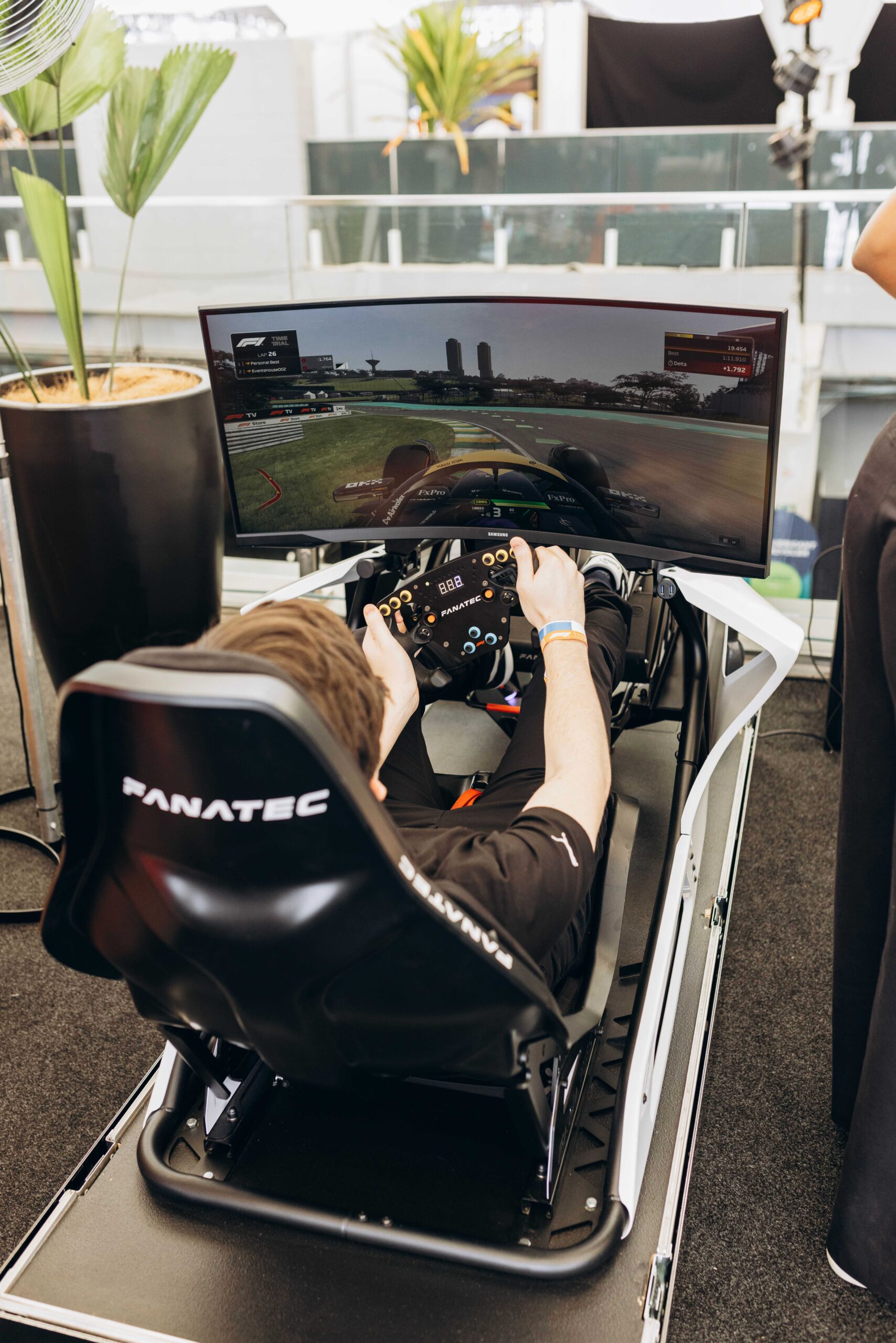
Sim racing set ups can start as low as a couple thousand
dollars and they don’t require any prior racing experience.
Photo courtesy of Jonathan Borba / Pexels


