
Calgary hosts Music Cities at the National Music Centre
Lacey Holowaty, Staff Writer
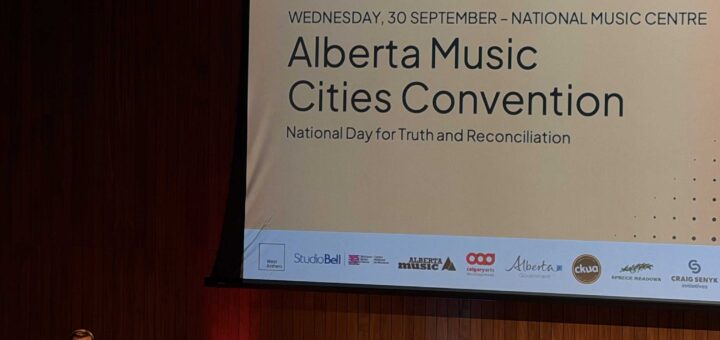
The Alberta Music Cities Convention brought hundreds of delegates from around the world to the National Music Centre in September 2026.
This year’s conference marked the 11th year of the program, which has been held in numerous countries worldwide.
The purpose of the conference is to bring together music industry professionals and policymakers to discuss the importance of musicians and the local economy, according to Shain Shapiro, founder and chairman of Sound Diplomacy, which is the organisation behind the event.
Pandemic limitations
In early 2022, Music Cities initially selected Calgary and Edmonton as convention hosts for that year, but due to pandemic restrictions, they pivoted to a fully virtual program. Despite the shift, the convention drew over 550 delegates from around the world.
Shapiro says the virtual edition of the conference just “wasn’t good enough,” so Sound Diplomacy, in partnership with Calgary’s West Anthem, decided to host the event in Calgary once again.
Back and better
The event took place from September 29 to October 1, and since the convention coincided with the National Day for Truth and Reconciliation, Shapiro says they decided to begin with a morning dedicated to Indigenous economic issues.
The convention officially kicked off on Wednesday, Sept. 30, with an opening prayer and song led by Siksika Nation Elder Bryan Little Chief, highlighting the importance of Truth and Reconciliation Day.
David MacLeod, CEO of Native Communications Inc., then gave a presentation about Indigenous representation and recognition in Canada’s music industry. According to MacLeod, over 90 Indigenous artists were nominated for last year’s JUNO awards, but he also spoke about the importance of policies that commit to promoting Indigenous inclusion in the industry.
“There’s so much vast richness and beauty within our community,” he said during the presentation. “I’ve met so many artists over the years and heard their stories—it’s beautiful.”
Calgary takes the stage
Calgary Mayor Jeromy Farkas appeared at the convention and took the stage to talk about the importance of fostering Calgary’s success as a staple music city in Canada.
“Great music isn’t created by City Hall,” Farkas said during his speech. “It’s created by people. It’s created by community. It’s made from hard work and passion. It’s a craft.”
According to Farkas, the music industry contributes around $2.5 billion to Alberta’s GDP and supports more than 23,000 jobs that generate $5 billion in annual economic output.
In an interview following the morning programming, Farkas says employment opportunities for younger talent have transformed from something Calgarians would deem nice to have to something that citizens now need.
“Calgary is about to compete [in the music industry] at a level we’ve never competed at before,” Farkas says.
He also says that to ensure Calgarians have access to a “great quality of life” and “affordable communities,” Calgary needs to support artists with both physical spaces to enjoy music and sustainable operating funding.
According to Farkas, Calgary’s return on artist investment is at an incredible high.
“Other cities are begging for that type of return on that type of investment,” he says. “If we don’t act now, we stand to lose the most.”
Premier(ing) at the convention
Alberta Premier Danielle Smith also made an appearance to describe how she’s supporting emerging Albertan artists, such as by creating and appointing Alberta’s first Music Commissioner, Jennifer Venance.
She cited Nashville’s development over the past few decades as evidence of the potential Calgary holds as a music city, and has coined the term “Nashville North” as a new moniker for the city.
Smith highlighted five “key things” the Alberta government intends to do to support artists in the province.
The first was to “build the musical ladder,” which Smith explained she intends to create places for musicians to play at each stage of their careers — whether that be smaller, medium, or larger-capacity venues.
Secondly, Smith said the government needs to “create places where music and city life come together.” This includes lively neighbourhoods where people can walk from a restaurant to a small music venue or a larger show, and then to a bar or cafe.
Smith’s third point aims to ensure musicians can actually afford to live and work in the province.
“If artists can’t afford housing or rehearsal space, or studios, or commercial space, they’ll go somewhere else,” she said.
Smith said the fourth item on the list was to connect music to tourism and noted that Calgary already has an advantage.
“And finally, we need to make music part of Calgary’s identity,” Smith said. “Imagine someone in Toronto, or Vancouver, or Los Angeles, or London hearing the words ‘Calgary, Nashville North,’ and immediately knowing what that means.”


