
MRU’s International Women’s Day both celebrates and teaches
Karra Smith, Staff Writer
At Mount Royal University (MRU), International Women’s Day (IWD) is recognised as a time to celebrate and learn about leading women within our campus community and beyond.
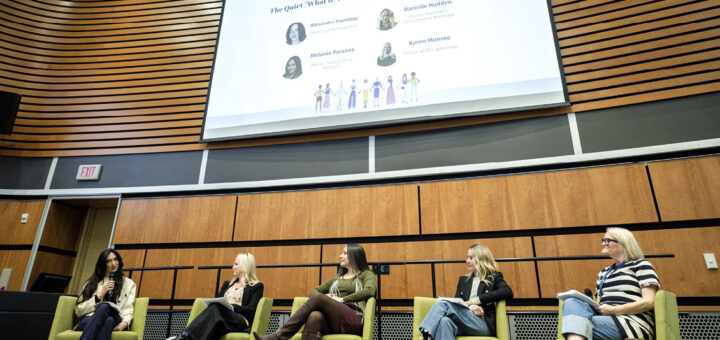
Ross Glen Hall and the surrounding classrooms hosted a range of panels on March 10, with speakers from all walks of life discussing topics including women in STEM, overcoming workplace barriers, mentoring and more.
Tala Abu Hayyaneh, president of the Students’ Association of Mount Royal University (SAMRU) and one of the panellists at the IWD event, spoke about the challenges women face in positions of authority and the need for strong role models within the community and workplaces.
“We also talk about brave spaces and what it’s like to cultivate these and allow women to step into leadership not having full answers for everything,” she says. “But also embracing messy leadership along the way and allowing other women who have been in leadership for a longer time to lead by example.”
For Abu Hayyaneh, IWD at MRU is an opportunity to share unique perspectives and platform the struggles women face and overcome daily.
“I think women have long proven themselves in many different spaces,” Abu Hayyaneh says.
Another advocate for more leading female figures in male-dominated fields is Melanie Rathburn.
Rathburn is a vice dean in MRU’s Faculty of Science and Technology. A barrier she has recognised for women entering or looking to enter STEM for the first time is the low representation.
“Sometimes it’s a lack of confidence. They might not have mentors or role models who emulate who they are. So they don’t see themselves as doing it,” she says.
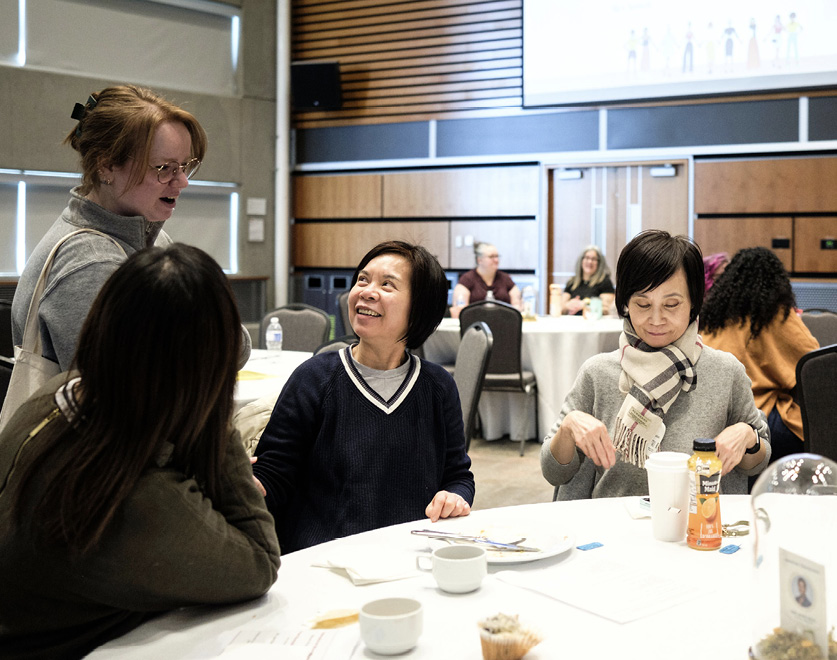
Women gather to share stories at Ross Glen Hall at MRU. Photo courtesy of Mount Royal University
For Rathburn, this is why celebrating female voices and incorporating both faculty and student perspectives is important.
“I think students sometimes have a more nuanced and a more developed understanding of some of these issues than some of the faculty,” she says.
Rathburn has witnessed many women in STEM overwork themselves to prove they belong, which she says is understandable but not sustainable.
“You know, you want to do well, you want to succeed, you want to get that right mark. But it’s not always about that. It’s about the journey along the way,” she says.
And Rathburn isn’t the only person to recognise this pattern of overexertion, particularly among women.
Liza Choi, an associate professor in the School of Nursing and Midwifery at MRU and a speaker at IWD, says the invisible workload women carry in addition to their preexisting job description is normalising exhaustion.
For Choi, this day of advocacy is a chance to not only celebrate women but also learn what actionable steps can be taken to ensure movement in the right direction.
“International Women’s Day is a powerful moment to say, strength in community is not a slogan, it is infrastructure,” she says.
While discussing the topic of ‘Burnout to Breakthrough’, Choi says oftentimes the care women demonstrate in their jobs, or schooling, is “exploited as an unlimited resource.”
Her lecture focused on the idea that achieving one’s goals doesn’t mean working to the point of feeling drained.
“When burnout becomes normal, it is not a personal problem. It is a cultural signal,” she says.
For many, the idea of burnout means failure, but Choi says this issue is systemic and changing the narrative to focus on strength and growth is the first step in resolving these inequities.
“Breakthrough doesn’t mean we fix everything. It means we stop carrying it alone, and we start shifting conditions together.”


