OPINION: Union dues and provincial blues
Ryan Montgomery, Staff Writer
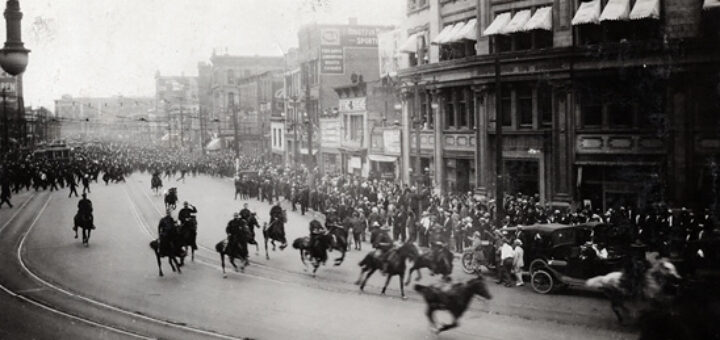
The last time anyone in Alberta said the terms “general strike” with any sense of gravity or urgency was a long time ago. The year 1919, specifically, was a time of mass labour upheavals across Canada. This series of strikes was called The Great Labour Revolt, either an ominous title or a triumphant one, depending on whether or not you were writing the paycheques or receiving them.
These strikes were in response to multiple factors, among them rising costs of living and unemployment (sound familiar?) and were only put down after a detachment of RCMP officers fired into a crowd of strikers in Winnipeg, killing two, an event known as Bloody Saturday. I guess they just gave things cooler names back then.
A general strike is a strike consisting of unions from a wide variety of industries with the goal of creating a strike so wide-reaching and disruptive that the government is forced into reaction.
“General strike” was a phrase relegated to the annals of obscure labour history and the wet dreams of armchair communists.
That was, until Oct. 29, when Danielle Smith’s provincial government invoked the notwithstanding clause to put an end to a nearly four-week-long teachers’ strike and impose a new contract on the union.
The strike began on Oct. 6 after the breakdown of negotiations between the province and the Alberta Teachers Association (ATA), the union representing all public school teachers in Alberta. The teachers’ primary goal in negotiation was a cap on class sizes, a demand that the province flatly denied, citing cost reasons and a lack of brick-and-mortar space. And just like that, an impasse was found, a strike was called, and over 50,000 Alberta teachers left their classrooms for the picket line.
The ATA would strike until the aforementioned date of Oct. 29, on which the provincial government passed Bill 2, otherwise known as the Back to School Act. I bet in 1919, they would have given this a cooler name.
The bill, which was hastily passed at 2 a.m., imposed back-to-work legislation on the ATA and forced the teachers back to work. Back-to-work legislation is a bill passed by a government which imposes a new agreement on a striking union and thereby forces them back to work. This is not the particularly controversial part; what is contentious is the second part of the legislation.
The provincial government invoked the notwithstanding clause –a particularly autocratic constitutional provision that allows a government to bypass certain sections of the Charter for a period of five years, to restrict the union’s ability to strike for a period of four years and thereby ensuring that the teachers cannot fight the agreement.
They also imposed a daily fine of up to $500,000 a day for any organisation that defies the order.
This iron/ham-fisted course of action by the province elicited a fierce reaction from Alberta labour. The Alberta Federation of Labour (AFL), the unified body which represents 26 unions across Alberta, constituting over 170,000 workers, harshly condemned the provincial government.
President of the AFL, Gil Macgowan, in a fiery speech on October 29, paraphrased WW2 era Prime Minister Mackenzie King.
“Not necessarily a general strike, but a general strike if necessary,” he said.
There’s a reason a general strike hasn’t occurred in Alberta for over a century. They’re an incredibly drastic measure.
According to Macgowan, this is the reason it hasn’t happened yet, saying, “We don’t have systems and mechanisms for this, there’s no ‘general strike’ button.”
Questions of the legality of a general strike still loom over the ATA, and what the province’s response would be. That being said, the unprecedented nature of the province’s actions may just warrant such a drastic action. If the government can legislate away the workers’ right to strike, and the union doesn’t do anything about it, then what are they there for?