
From Barbie to ballots: Nicki Minaj’s public evolution
Anais Loeppky, Staff Writer
In the era of social media, artists are scrutinised for a lot more than just their art. They’re expected to be brand strategists and, at times, political participants and activists. A single post can travel faster than a press release, and public reaction often unfolds in real time.
From rap persona to public figure
Few artists reflect this media shift quite like Nicki Minaj. When she initially broke into the mainstream with the release of her 2010 album, Pink Friday, her brand centred on bold femininity within the male-dominated rap industry.
Her early career was defined by this branding, as well as her striking performance visuals and brazen lyricism. But, over the years, Minaj’s public identity has shifted beyond music.
From questioning industry decisions online to engaging in debates about public policy, her commentary has increasingly intersected with larger political conversations.
As cultural expectations around celebrities have changed, with audiences expecting public figures to take a stance on social issues, so has Minaj’s brand evolved.
Her career trajectory reflects a new industry landscape, in which fame and politics now operate together, often in ways that blur the boundary between personal expression and public influence.
The Bible, the president and the backlash
Recently, Minaj has made global headlines because of the visibility and frequency of her engagements with high-profile political figures and events.
Last month, Minaj broke the internet after sharing a photo on X of a Bible signed by U.S. President Donald Trump. In the post, Minaj calls it “one of the most meaningful gifts I’ve ever received in my entire life.”
The Bible sparked discussion online, with reactions ranging from open praise to criticism of the political symbolism and the religious implications of the signed book.
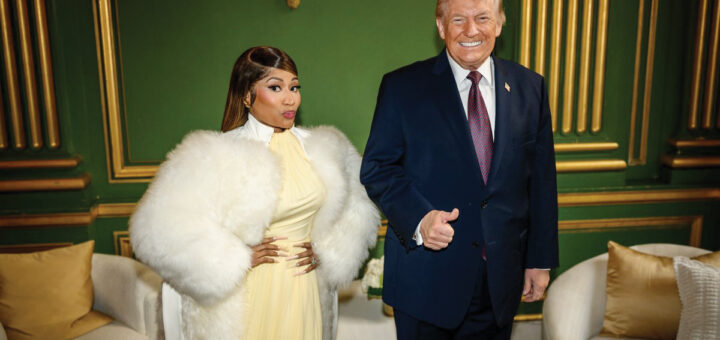
This moment follows several other public interactions between Minaj and Trump that have unfolded in recent months. This January, she appeared alongside Trump at the U.S. Treasury Department’s launch of the “Trump Accounts” program, where she publicly described herself as his “number one fan.”
Late last year, Minaj also attended an annual conference hosted by Turning Point USA, a right-wing non-profit, where she joined the organization’s CEO, Erika Kirk, onstage.
These public endorsements and appearances have generated both support and criticism among her followers, as coverage and online conversations highlight how her political associations have become part of her broader public identity. She faced significant backlash across social media platforms because of this, with comment sections and trending discussions reflecting the sharp divide amongst fans and the media.
In response to the intense reaction, Minaj temporarily deactivated her Instagram account, further fuelling online speculation and commentary. While she did not provide an explanation for the deactivation, the timing did not seem coincidental.
Despite her motive, the move reflected how celebrity political engagement enables immediate response to controversy, where even the act of stepping away from social media becomes part of the broader narrative.
The backlash Minaj has received has taken multiple forms, including fan debates over loyalty, calls for boycotts and renewed scrutiny of her past statements on public health and government policy. Supporters, meanwhile, framed the criticism as evidence of increasing intolerance toward dissenting political views in entertainment spaces.

Erika Kirk (left), CEO of Turning Point USA, sits down with Nicki Minaj (right) at the
AmericaFest conference last December. Photo courtesy of Wikimedia Commons
Fan culture and political identity
Part of what made the online reaction so intense is the audience space Minaj has built over the last decade and a half. From the start of her career, Minaj has held a visible place within queer fan culture.
Her exaggerated alter egos and theatrical visuals made her a staple in drag performances and Pride playlists. She has also frequently acknowledged the loyalty of these communities, often referring to her “Barbz” as powerful and dedicated.
It is then no surprise that her recent political associations landed differently for some fans. Online conversations showed visible tension within parts of her queer audience, with some expressing discomfort given Trump’s record on LGBTQ2SIA+ issues, which advocacy groups have criticised over the years. Others defended Minaj’s right to personal political alignment, arguing that fandom does not require ideological agreement.
The moment underscores how deeply intertwined celebrity branding can become with specific communities. When an artist’s image is closely connected to marginalised or identity-based audiences, political gestures are rarely received in isolation.
In Minaj’s case, the response revealed how shifts in public positioning can ripple through fan cultures that have long been central to branding.
The artist, the audience and the algorithm
Minaj’s evolution speaks to something bigger than one artist or one political moment. It reflects how dramatically the expectations surrounding celebrities have changed.
In an era where social media collapses the distance between public figures and their audiences, artists are expected to be performers as well as personalities, commentators and even political figures, whether they intend to be or not.
For Minaj, that evolution has played out publicly and in real time. The same platforms that once amplified her music and persona now amplify her political gestures and the reactions to them. Her brand now exists within a landscape where personal belief, public alignment and audience identity intersect.
Rather than existing on separate tracks, fame and politics increasingly move together. Minaj’s story illustrates how difficult it has become to separate the art from the individual behind it, and how quickly a celebrity’s public image can expand beyond entertainment into something far more complex.


