
OPINION: Analysing Trump’s rhetoric surrounding annexation
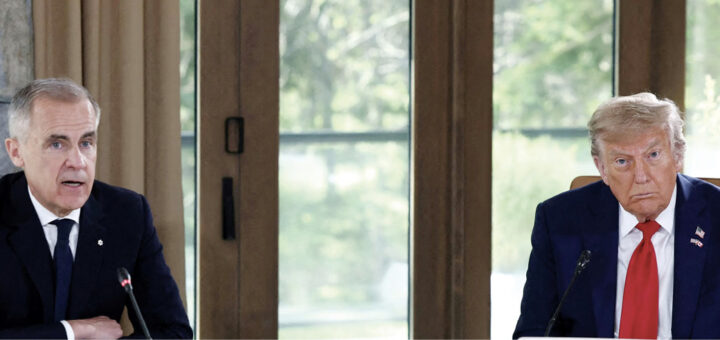
Vlad Semeshko, Staff Writer
Donald Trump’s remarks about Canada becoming the “51st state” are often dismissed as jokes or delusions rooted in dictatorial ambitions. Nevertheless, when assessed through an economic and geopolitical lens, these comments reflect broader strategic interests rather than provocations aimed at simply demeaning his rivals.
The Trump administration masterfully utilises social media and television in the game of politics, continuously shaping the perception and narrative of the American people. Through assertions made at the upper echelons of power, algorithmically repeated on the nation’s phone screens, the desired interpretation of politics is exerted on the populace.
Trump is sure to never miss an opportunity to use charged language in front of cameras, such as the “51st state” and the “Governor Mark Carney” comments. The goal seems to be consistent normalisation of these ideas for broader acceptance before any direct government action.
The annexation narrative stems from a geostrategic trend of great-power realism and the renewal of unmasked American imperialism, now titled the Donroe Doctrine by Trump himself.
This return of the administration to Manifest Destiny as the guiding thought behind the role and responsibilities of the United States in the region ideologically propagates not just the desire to expand American territories in the hemisphere, but establishes that goal as a duty.
In the new multipolar world order with slowly fading institutions and systems that upheld international law for decades, state-to-state interactions are increasingly dominated by economic and military strength, in which imperial states prevail through coercive market or territorial expansion.
Considering the idling U.S. military behemoth with a trillion-dollar budget, the Department of War — formerly the Department of Defence — is itching for an opportunity to show military supremacy and advanced technology through action.
Like the secret pulsed energy weapon used in the Maduro capture operation, which left Venezuelan soldiers bleeding from the nose and vomiting blood, famously titled the “discombobulator” by Trump.
“It’s never been my intention to make Greenland the 51st state. I want to make Canada the 51st state. Greenland will be the 52nd state. Venezuela can be 53rd,” Trump joked at the annual dinner of the Alfalfa Club, an exclusive organisation of CEOs and politicians.
Dismissing such remarks as theatrics underestimates the power of narrative popularisation in policy frameworks.
Canada, like Greenland, is a large landmass rich in resources, minerals and undeveloped land. Donald Trump, a career real estate tycoon and political entrepreneur, has framed territorial expansion through the language of deal-making and asset acquisition rather than international law or respect for sovereignty.
Besides additional tax revenue and vast economic opportunities for large American firms with favourable regulatory frameworks, or lack thereof, U.S. annexation of Canada and Greenland would most importantly grant America complete control over the thawing Arctic region, which is the real gem for the long-term geopolitical strategy.
Covered in immense oil and mineral deposits, competition over controlling the Arctic is the leading trend among great powers of the multipolar world order. Russia, China, Europe and the U.S. all strive to secure a strong position for the approaching future when a solid foothold in the Arctic guarantees control over global shipping routes, dictating economic capacity and power of state in the face of changing times.
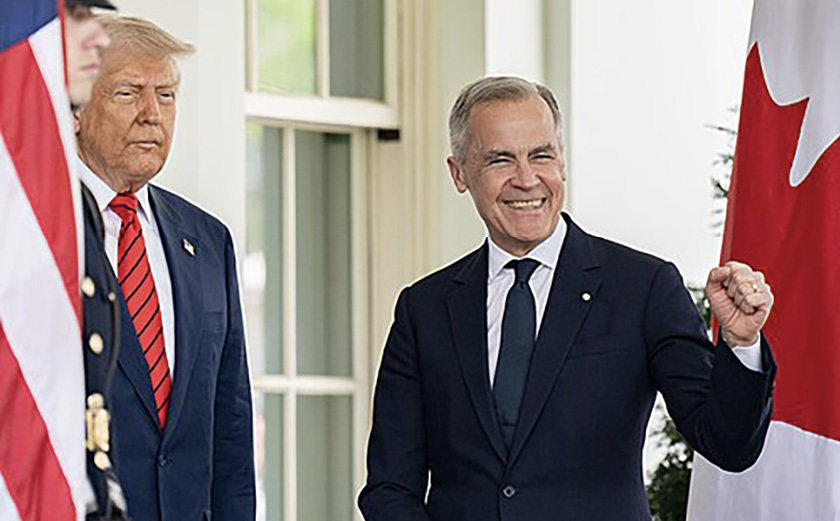
Since Trump’s re-election, tariff threats have been no stranger to Canada, including
a recent call for 100 per cent tariffs on Canadian goods if Canada strikes a trade deal
with China. Photo courtesy of Wikimedia Commons
Many Canadians may wonder, ‘how can half of Americans be so blind to accept and follow such demagoguery?’ One can point out that the Canadian population is not so different in regard to adhering to the dominant domestic narratives that flow down from the top.
In our case, Canada, dominant discourse trickles down in a centralised manner through the government-funded Canadian Broadcasting Corporation (CBC).
In the absence of the ideological and normative fluff which divides the population through emotionally charged discourse, CBC, just like Fox News, CNN or any other mainstream media, serves the interests of profit before the corporate donors, power brokers, and its own shareholders.
Whether it is the acquisition of new capital for the sake of U.S domestic firms, or safeguarding it for the sake of international businesses and investors in the case of Canada, the driving factors remain consistently the same: power and profit.


