Russia advances on Ukrainian defences
Vlad Semeshko, Staff Writer
The December fog has settled on the Donbass front lines, hinting at the steady transition of the Russo-Ukrainian war into its third winter since the start of the operation. The last few months have been highly eventful for the conflict in all of its dimensions.
Developments such as the leaked peace plan, encroaching Russian encirclement in Pokrovsk, and numerous corruption scandals from the government halls of Kiev may collectively suggest that the time to pay attention to the region is now.
As the year draws to a close, the battlefield conditions, infamously synonymous with Russian winters, indicate that the Russian army’s offensive, which began in May, is coming to a halt.
Though the momentum accumulated throughout the summer has been fading, the overall effects on the Ukrainian front lines have been significant. The offensive pushed forward along six major axes advancing in the direction of Kupiansk, Seversk, Pokrovsk, Novopavlivka, Huliaipole, and Sumy, challenging Ukrainian control over eight strategically significant cities across the front.
As a result, the armed forces of Ukraine are facing growing defensive crises, scrambling to plug gaps with increasingly scarce reserves and manpower shortages, all in the face of dwindling material support from the NATO member states.
The attention is centred on Pokrovsk, a city located in a cluster with two other towns, Mirnograd to the east and Rodinskoe to the north.
Pokrovsk has in the past been described as one of the few remaining significant strongholds in Donbass, keeping the Russian army away from capturing the rest of the region for the past year.
Despite most of Pokrovsk being held by the Russian forces, urban combat persists in the city. With Russian troops capturing a chunk of Rodinskoe in an encircling move north around Mirnograd, the city was put in a pocket and directly at risk of another potentially devastating encirclement for Ukraine.
North-east of Pokrovsk, around 70 kilometres away, lies the town of Konstantinovka. Now separated by Russian troops, Konstantinovka is characterized as the ‘gateway’ to Slovyansk and Kramatorsk, cities that are of high importance to Moscow.
Slovyansk and Kramatorsk are considered to be the “last jewels” of Donbass remaining under Ukrainian control. Kramatorsk is the de facto administrative centre of the Ukrainian-controlled Donetsk oblast, and Slovyansk is of symbolic significance to the conflict, being the first location of open, armed confrontation between pro-Russian separatist forces and the Ukrainian government back in 2014.
While the Konstantinovka ‘gateway’ maintains its defences, the Russian Commander of the army group, Sergei Medvedev, said to Vladimir Putin in a briefing that the town would be captured by mid-December, with Putin urging caution and advising against rushing the operation.
Nevertheless, this estimation is considered to be unrealistic by Western war analysts.
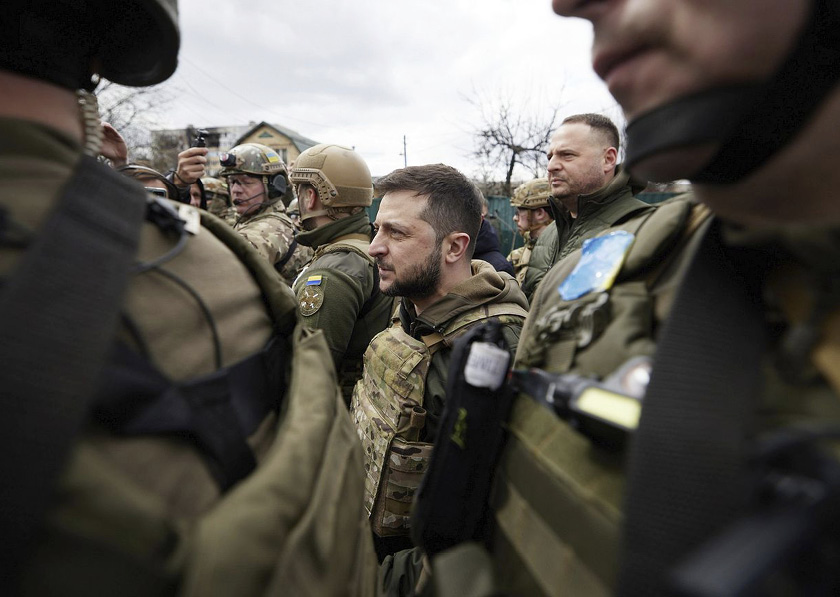
Diplomatic tensions rise as Russia continues their advances in Ukraine. Photo
courtesy of Canadian Affairs
Ukraine is facing frontline challenges and a deepening logistical nightmare, priorities in Kiev have shifted more towards negotiating a favourable diplomatic resolution of the conflict. The leaked 28 point peace plan developed by both the United States and the Russian Federation revealed the ongoing divide between American and European NATO counterparts.
The initial peace plan included security guarantees for Ukraine along with territorial concessions favouring Russian demands, recognizing Crimea, Donetsk and Luhansk oblasts as part of Russia. The plan additionally included several points unrelated to Ukraine surrounding direct agreements between the United States and Russia.
U.S. President Donald Trump made efforts to pressure Ukraine into signing the agreement, but the absence of consultation with Ukraine and the European allies during the plan’s formulation caused a reaction from numerous NATO members, leading them to bring forward a proposal of their own.
Recently, there have been many changes to the points in the proposal from both the Trump administration and European allies. With the original 28-point plan now seemingly terminated, it is considered to be the starting framework for negotiating and finalizing a peace agreement.
Ahead of further talks set to take place between the White House and Kremlin envoys, Putin doubled down on Russian demands, stating that a ceasefire is possible only if Kiev’s troops withdraw from the territory claimed by Moscow.
An emphasis was made by Putin, proclaiming the inevitability of the return of Donbass into the Federation, highlighting that relinquishment of any territorial gains is out of the question for Moscow.
The prolonged war is nearing its fourth year mark of direct Russian military involvement since the invasion in February 2022. While increased dialogue brings hope for a settlement in the near future, lack of compromise and conflicting geopolitical realities continue to drive apart two not-so-long-ago brotherly nations.