Calgary, meet your new mayor
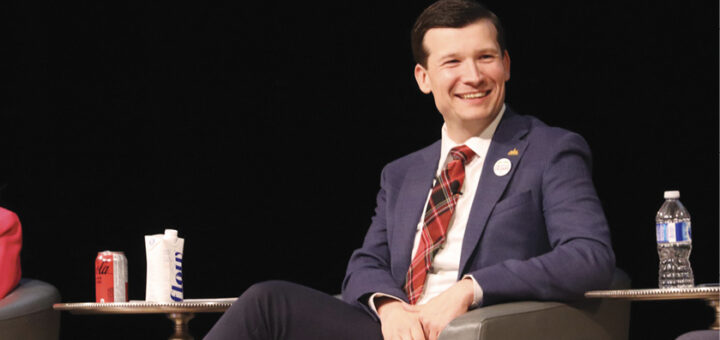
Khaoula Choual, Staff writer
On Oct. 20, Calgary chose its mayor. It was a tight race between Jeromy Farkas and Sonya Sharp. This recent election saw low voter turnout, a recount, long wait times, and former mayor Jyoti Gondek conceding. This is the first time in 45 years that a mayor has only served one term.
After a long night of hand counting on Oct. 21, it was decided that Farkas would be Calgary’s next mayor.
Who is Jeromy Farkas?
Farkas was one of the youngest councillors elected in Calgary. Before the election, during the debate, Farkas was known as a “flip-flopper.”
The CBC reported that many ward councillors, like Shane Keating, described Farkas as a “disruptor,” describing him as impossible to work with, and refused to support ideas of fellow councillors as they did his.
“He’d knock everyone else’s sandcastle so his was the highest rather than doing something to raise his castle or ideas to the top,” said Keating in a CBC interview.
Farkas said in a podcast with the National Observer in 2023 that he reflected on his 2021 campaign and Ward 11 councillor days and that he is “embarrassed.”
He branded himself during his 2021 mayoral campaign as “your conservative choice!”
“I’ve made mistakes, and I think it means saying the courage, having the courage to say that you are wrong, that you’ve learned,” said Farkas during a debate hosted in the Jack Singer Hall on Oct. 8. “Leadership means being willing to show up on stage like this to admit that you are wrong.”
He cited newfound change for his not-for-profit experience. Now, he had to prove to Calgarians he had changed.
Farkas didn’t capture all the votes of Calgarians, but just enough to get him to win the election.
Lower voter turnout
The CBC reported that one in 10 Calgarians voted for Farkas.
In 2021, when he previously ran for mayor, his 116,700 votes indicated a significant increase in voter turnout compared to 2025. Of 896,042 eligible Calgarians, fewer than 350,000 voted. 46 per cent of Calgarians voted in 2021. That number went down to 39 per cent in this mayoral election.
The long waits potentially deterred many voters, with some voters waiting hours.
“Those costs are really to account for the hand counting of the ballots,” said Calgary’s returning officer, Kate Martin.
The long lines were due to the time it took election workers to uphold the electoral registry and issue three separate ballots for a mayor, a councillor and a school trustee.
According to the Sprawl, the reasoning for hand counting was due to the provincial legislative changes that switched from electronic tabulators instead of being tallied by hand.
“With the prohibition of the vote tabulators—moving to a hand count—that is going to cost us more in terms of the number of voting stations, the number of election workers that we’re hiring, and, of course, all the supplies,” said Martin.
What is the Local Authorities Election Act?
Farkas led with a margin-of-victory (MOV) of 581 votes, with 91,071 votes total. Sharp picked up a close 90,490 votes.
Under the Local Authorities Election Act, Sharp requested a recount. If the difference in the vote between the first and second candidates is 0.5 percent, the second may request a recount.
Sharp said in a statement, “Given the margin-of-victory for Mr. Farkas is only 585 votes or 0.16 per cent, I believe it is appropriate to request the Chief Returning Officer undertake a recount of the ballots to ensure the accuracy of the election outcome.”
The provincial government’s banning of electronic vote tabulators was at play for Sharp’s reasoning for requesting a recount. She cited that due to a long night, long lines, and hand-counted votes, mistakes were bound to occur, as she insisted she isn’t criticising the election workers.
“Given the razor-thin margin-of-victory in this election, it makes ample sense to review and double-check that appropriate processes were followed, and the count is accurate,” Sharp said.
A recount was completed on Oct. 28. Both Farkas and Sharp gained more votes this time, with an MOV of 616. The updated numbers released were Farkas’ 91,112 to Sharp’s 90,496.
On Tuesday, he addressed Calgary as a whole.
“To every Calgarian, whether you voted for me or not, I will be your mayor. I will work alongside you, listen to you, and stand up for you every single day,” Farkas said.
On Wednesday, Oct 29. Farkas was officially sworn in as mayor after the recount.