OPINION: Who wore it best at the 2026 Olympic Games
Katrina Ebuenga, Staff Writer
Hosted in the fashion capital of the world, Milan, the 2026 Winter Olympics challenged countries to step up their creative game.
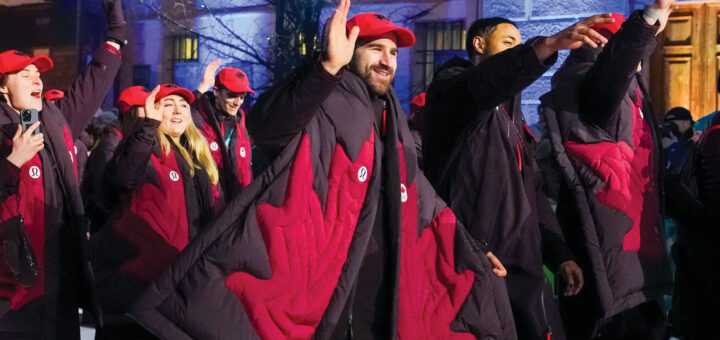
Rocking the maple leaf, Team Canada stirred up quite a controversy surrounding one item seen at the opening ceremony. The alleged quilted puffer wrap vest sparked questions about whether or not it is an enlarged scarf, or rather, some sort of sleeping bag.
With the Winter Olympics being held in the same city as the famed Milano Fashion Week, the expectations for how the teams presented themselves were high.
While some brand partnerships stepped up this year, others feel flat. And with trending controversies like Team Canada’s athletic kits, the ranking for best and worst teams changes depending on who you ask.
Standout creative teams
Starting strong in terms of creative design, Team Mongolia leads with a strong sense of cultural expression. Differing from the other teams that adopted a typical puffer or peacoat jacket, Team Mongolia used the spotlight to showcase their cultural identity and nationality, wearing a traditional deel at the opening ceremony.
Their display of quiet, yet meaningful luxury showcased a high-quality brand deal that refused to compromise on purpose, contradicting Team USA who signed multi-brand partnerships.
Team Mongolia’s designer, Goyol Cashmere, incorporated materials such as fur, silk trimmings and blue cashmere into the kits, representing the “Eternal Blue Sky” that the country is known for. Also included with the traditional deel and robe, the knit sweaters feature mountain-themed designs, a reference to ger (yurt) culture.
Team Norway comes in a close second with the consistent designs of their knit sweaters. Designed by Dale of Norway, the timeless sweaters continue to pay homage to past creative choices and athletic teams. Although their athletic attire does not display the country’s flag, fans can still recognise the team because of the classic Norwegian patterns.
Team Haiti and Team Brazil also deserve recognition for their creativity in design. Team Haiti’s Olympic look was created by Stella Jean, an Italian-Haitian designer, who hand-painted the iconic red horse design seen on the team’s jacket and skirt.
This subtle incorporation of nationality can also be seen in Team Brazil’s puffer jacket, designed by Moncler, that appears plain on the outside, but is flag-lined on the cape-inspired outerwear.
Dressing Team Canada
While teams like Mongolia and Norway have stayed on top because of consistent designers and brand partnerships over the years, Team Canada’s shift to Lululemon has fans questioning the partnership.
In the past, Team Canada has memorably partnered with the Hudson Bay Company and Roots, two well-known Canadian brands that have represented Team Canada for years.
Lululemon’s partnership with Team Canada began at the 2022 Olympics in Beijing, China, with their plain yet bold red design.
This year, they have expanded their athletic kits to include 42 apparel pieces, with some pieces even straying away from their signature red. Lululemon has elevated its athletic apparel in activewear, making this year’s kits runway-ready from opening to closing ceremony.
Despite their successes, Team Canada can’t seem to escape the infamous quilted puffer vest. The garment was front and center at the opening ceremony, proudly displaying a large maple leaf plastered on the front.
The vest can be seen being worn as a waist cover in the promotional photos on Lululemon’s official website, emphasising the variety of ways it can be worn by athletes. Lululemon’s intent was seemingly diversity in style, allowing athletes to adorn the clothing however they see fit.
Even with the promotional photos, athletic kit unpacking videos have gained traction on social media, as content creators and athletes express their confusion about what the vest is meant to be. At the beginning of the Olympics, Canadian snowboarder Juliette Pelchat posted a video wearing the vest, with comments quickly filling her inbox about what she was wearing.
However, although met with plenty of confusion, the vest also gained support from proud fans. For them, the vest is quintessentially representative of Team Canada and the Canadian flag, or better yet, an older version of a Tim Hortons cup. This call back to the ‘90s is a perfect and arguably innovative way to bring nostalgia into representing national identity.
Unlike the other pieces from the past, this wrap vest has caused a loud commotion to what the next years may look like for Team Canada with their multi-year partnership with Lululemon.

Team Mongolia partners with Goyol Cashmere to create
timeless and traditional athletic kits. Photo courtesy
of Instagram / @goyolcashmere.mn
Our neighbour to the south
Team USA has been consistent with its longstanding partnership of 20 years with Ralph Lauren. Embodying the “American spirit,” as described by David Lauren in Vogue, this year’s line incorporates the traditional colours of reds, whites and blues, using Ralph Lauren’s traditional styles of cable-knit sweaters and fleece jackets.
Team USA has also partnered with Skims and Nike, making them the only team with multiple partnerships. With Skims covering loungewear and Nike covering activewear, Team USA is overstocked with apparel for any situation.
And, surprisingly, Nike’s trending eagle skirt made from recycled materials has not gathered as much attention as Team Canada’s vest. The skirt-blanket is at least on-brand for its resourcefulness, made from recycled plastic bottles and polyester to reduce mass waste.
While the large print of an eagle is boring and tacky, it is inspired by the Colorado mountains as a tribute to the athletes’ training centre, located in Colorado Springs.
From start to finish, the Olympic catwalk was one you did not want to miss. From American tackiness to Canadian authenticity, the Winter Olympic outfits had their own competition to win amongst fans.