
Era-ending loss ushers in new era for Team Canada
Naomi Campbell, Staff Writer
Since 1920, Team Canada men’s hockey has established a legendary reputation in the Winter Olympics, with nine gold medals. Over the decades, Canada has led all countries, with 17 medals in the sport –– five silver and 3 bronze. Every four years, a group of players is selected from the best of the best to represent their country in the Winter Olympics. NHL players were disallowed from participating in the 2010 Olympics onward, until the ban was lifted at the 2026 Milano-Cortina Winter Olympic Games.
Back in 2010, Team Canada’s roster was decorated with many of the best players in the world. Skaters such as Jarome Iginla, Roberto Luongo, Scott Niedermayer, Drew Doughty and Sidney Crosby dominated the tournament. This group went down in history as one of the best teams of all time, including the iconic story of Crosby’s ‘Golden Goal’ in overtime against the United States. Crosby also won a Stanley Cup one year before those Olympics and went on to establish his all-time legacy with two more championships after.
New year, same superstars
When the Canadian roster was released for the 2026 Winter Olympics, the hockey world erupted, debating about which players should or should not have not made the roster. Many believed Connor Bedard deserved a spot on this year’s roster, especially after his performance at the World Junior Championships back in 2021-22 and 2022-23, where he won back-to-back gold medals, and his blazing hot start to the 2025-26 NHL season. Tom Wilson, known for his enforcer role on the Washington Capitas, is not shy of the penalty box and game suspensions, but some believed Bedard’s youth and offensive talents warranted him a spot over him.
Crosby and Doughty reunited after 16 years as the veteran presence of this year’s group. New to the Olympics, but not new to high-level tournaments, Connor McDavid and Nathan MacKinnon went hand in hand as the Alternate Captains for this year’s games. At just 19 years old, Macklin Celebrini set the record for the youngest Team Canada player ever and eagerly jumped up to the plate, hoping to make an impact with his teammates.
Crosby was named captain for the Canadian men’s team, placing him at the forefront of the battle to come as his fans worried that this could be his last time suiting up for Canada on the Olympic stage.
The Italian job
Canada got off to a great start in the round-robin stage, avoiding any losses. However, going into the semi-final game against Finland, Crosby was marked as injured, leaving the weight of the world to the rest of his teammates.
In international tournaments, if the captain cannot play, the head coach is required to choose a player to fill that spot. McDavid was honoured with the ‘C’ for the semi-finals game against the big-hitting group representing Finland, a role he became accustomed to after being named captain of the Edmonton Oilers in 2016.
With Canada down by two heading into the back half of the second period, the boys in red pulled out a heroic feat, punctuated by MacKinnon’s game-winning third-period goal, punching their ticket to the Gold Medal game.
(Tragic) end of an era
The final game could not have been scripted better as Canada prepared to face Team USA in a rematch of last year’s 4 Nations Cup Final. Canada came out on top in that tournament, being the first ever 4 Nations Cup Champions. Despite outshooting the USA, Canada was down by a goal until Cale Makar evened things up at the end of the second period. The stalemate stood until the end of regulation, necessitating a controversial 3-on-3 overtime.
For over 18 minutes, both goaltenders stood on their heads. With less than two minutes to go in the extra frame, New Jersey Devils star player Jack Hughes snuck through Canada’s defence and goaltender Jordan Binnington to win it for the U.S.
What the future will feature
Crosby’s long tenure as a Canadian captain likely ended as Hughes’ goal crossed the line, leaving a vacancy for arguably the most important position in global hockey. With him also goes Drew Doughty, while Mark Stone and Brad Marchand could conceivably call 2026 their final Olympic run as well.
However, the team still has plenty of stars in their prime years and some of the brightest prospects in the world waiting for their spot on future rosters. McDavid, MacKinnon, Nick Suzuki, and Mitch Marner headline Canada’s future offence as the next veteran core, while Cale Makar, Shea Theodore and Colton Parayko fill that role on defence.
Celebrini impressed many with his tournament-leading five goals and 28 shots-on-goal, firmly reserving himself a spot on the next Canadian roster, while Bedard will hope to make his Team Canada debut in 2030.
Mark Scheifele, Mathew Barzal and Ryan Nugent-Hopkins closely missed out on a roster spot this year, but have a strong case to grace 2030’s forward core, while MacKenzie Weegar, Matthew Schaefer and Owen Power will provide strong reinforcements for the future defensive unit.
Goaltending was a concern for Team Canada after Luongo and Price’s eras ended, and while Binnington provided historic performances at 4 Nations and this year’s Olympics, his time in a Team Canada jersey is likely over. Scott Wedgewood and Mackenzie Blackwood will provide stiff competition for Logan Thompson and Darcy Kuemper when it comes to deciding the trio of goalies Team Canada will employ in 2030.
Canada’s IIHF World Junior program also put some fresh new names on the radar for the next Olympic roster, including Gavin McKenna, Zayne Parekh and Michael Misa, among other burgeoning talents.
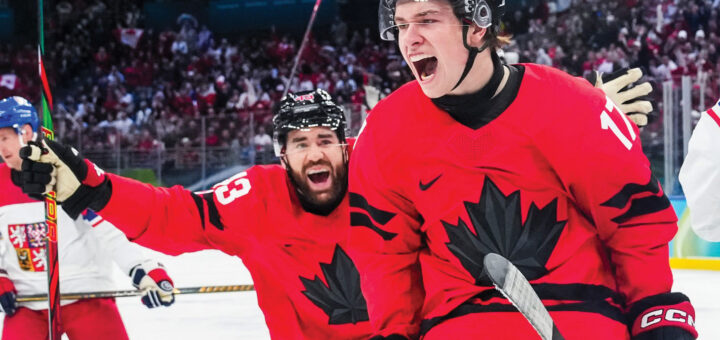
Team Canada wasn’t able to secure a gold medal at Milano-Cortina, leaving fans to wave goodbye to the legends that built the country’s modern reputation on a heartbreaking note. That being said, the future looks to be bright for the boys in red and white, with plenty of young emerging stars ready to fill vacating roster spots.


