
Making Mount Royal: Methodist mission to modern university
Manveet Kaur Waraich, Staff Writer
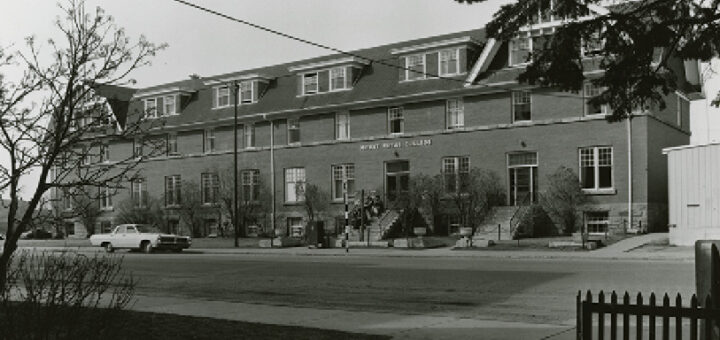
When Alberta became a province in 1905, it moved swiftly to establish public universities and shift control of higher education from churches to the government. But private religious institutions continued to shape the landscape, including Mount Royal College (MRC).
1911: Methodist Beginnings
David Baker, a historian and the MRC’s former president, wrote in his book that this was a crucial period for the founding values to take shape. Although its Methodist origins emphasised religious education, the college was grounded in cultural literacy, practical training, and service to the community.
“Methodists focused on niches not served or not served well by public systems,” reads his book, titled Catch the Gleam. “Their colleges were dynamic institutions…adding career programs to prepare people for the workforce, and forging partnerships with public institutions where appropriate.”
Surviving World War I / Strain of WWI
Although it was a strong start, Mount Royal’s early decades were rocky. The First World War and the Great Depression brought overwhelming financial strain. The new institution’s survival depended entirely on innovation.
“Programs were attuned to what students needed and wanted…it was academically entrepreneurial, constantly searching for new needs to meet,” writes Baker.
He also states that MRC “relied heavily on its boarding school function for revenue,” but because most students came from rural backgrounds, “rural penury implied scarcity for the College.” To keep MRC afloat, Kerby and house directress, Mabel Carrick, took numerous voluntary salary cuts of more than $9,000, and faculty lived in residence with students.
By 1930, with enrolment at its lowest and city high schools expanding, MRC made a decisive shift. According to Baker, it chose to “form an affiliation agreement with the University of Alberta and establish an identity for itself as a junior college,” eliminating elementary programs and duplicating the first two years of university so students could stay in Calgary and avoid relocation costs to Edmonton.
As the 1940-41 calendar put it, “to students who are looking forward to securing a university degree, the Junior College affords an opportunity to complete their first year without the necessity of leaving their own homes…to those who are preparing to enter more directly into modern life, [MRC] serves a useful purpose as a finishing school.”
This shift spurred growth. New facilities and housing (nicknamed the “Barn”), portable warhuts, library materials, labs, and auditoriums formed a campus. Enrolment climbed to 499 by the late 1930s, and “by the end of the decade, the college’s advertisements proclaimed that it offered first-year university courses” leading to degrees across arts, commerce, engineering and law, says Baker. He also believed that, “it was remarkable that the college survived while all of the other private colleges initiated in Calgary before 1914 disappeared.” Notably, the mandatory morning chapel was also made voluntary.
During this time, Baker explained that MRC proposed new forms of learning that relied on “inspiring teachers and student motivation,” forgoing strict requirements and textbooks. The University of Alberta and the Alberta Institute of Technology rejected this model multiple times, but MRC developed it anyway—what would later be known as continuing education.
Thriving in World War II / Strength in WWII
By 1942, Kerby retired and was succeeded by Reverend John Henderson Garden, a former MRC student. In stark contrast to the First World War, the Second World War brought financial stability. Wartime programs boosted enrolment to 630 students by 1943, allowing MRC to clear its debts.
Male students were required to join either the University Air Training Corps or the Officers Training Corps. Ultimately, the college formed its own flight squadron. Students trained in drill, navigation, first aid and aircraft recognition, while women in the university stream joined the Women’s War Services, training three afternoons a week. MRC also offered clerical programs for service members starting in 1941 and introduced a 25-week journalism course in 1944. Still, war took its toll, as more than 300 students served, and sixteen never returned.
By the 1950s, enrollment had tripled, and space was strained. The government offered MRC land for $1 per year at the Institute of Technology’s site, but the board chose instead to remain in the city core, raising $100,000 to build the Kerby Memorial Building. Baker suggests this may have been the only reason MRC avoided being absorbed by the Institute of Technology when it itself became a public college.
Yet space issues persisted. Students complained in the newly founded Reflector in 1962 about overcrowded dorms, cafeterias, classrooms, and parking. Meanwhile, MRC’s relationship with the University of Alberta grew tense. Baker explains that by the 1950s, the college was actively “reorienting its academic programs from the University of Alberta to American institutions,” giving it greater autonomy. That independence was challenged again when the University of Alberta opened its Calgary branch—now the University of Calgary. Still, MRC thrived.
Baker refers to a 1959 report asking why, “in spite of high fees and makeshift facilities,” did it “have more university-transfer students than it had had when it was affiliated with the university?” The answer: small classes, personal attention, and a mission built on accessible education.
Evening college further expanded MRC’s reach, allowing working adults to study at night and pursue upgrading or transferring credits. Baker referred to this as another example of MRC’s entrepreneurial instinct to meet community needs.
By the mid-1960s, the Reflector had shifted from school-spirit boosterism to open dissent.
“The answer…was student radicalism,” Baker writes. The paper published political commentary, cultural criticism, and provocative poetry, amplifying students’ frustrations with restrictive rules and even hosting calls for alcohol in lounges and for marijuana legalization.
“The ‘1960s’ had arrived at Mount Royal,” writes Baker.
From Church to State
When Jack Collett became dean in 1948, Mount Royal entered its final phase as a college. Despite every effort during the following six years—new programs, higher fees, fundraising—the college faced growing financial pressure and competition from subsidized public institutions. As Baker writes, “the private college was in a battle it could not win.”
In 1966, Mount Royal College became a publicly funded institution, opening the way for the modern university it would become.
A timeline of key events from 1911 to 2010 is available on The Reflector’s website, titled 100 Years of Mount Royal.

