
Dodgers’ double-play ends Canadian World Series dream
Zafir Nagji, Sports Editor
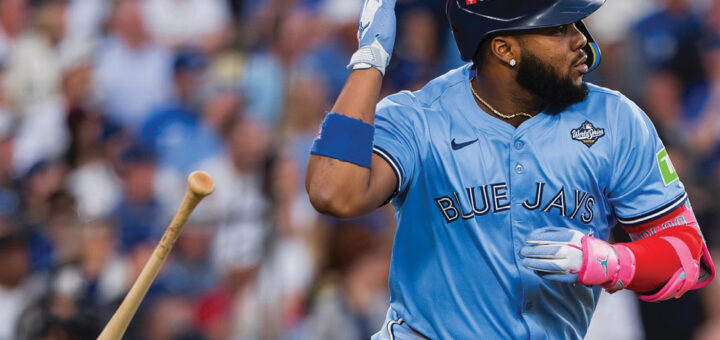
Millimetres. That’s how far away the Toronto Blue Jays were from winning their third-ever World Series title. After a league-best 49 regular-season comeback victories, Canada’s team earned a first-round playoff bye as the best team in the American League (AL), finishing as the MLB leader in hits. The whole country cheered them on through three tough playoff rounds, but the Toronto Blue Jays were defeated by the Los Angeles Dodgers in the 11th inning of the seventh game of a historic world series.
Starting off on the wrong plate
The Blue Jays were not good at the start of the MLB season. A 3-2 start showed potential in March, but after agreeing to a 14-year, $500 million extension with Vladimir Guerrero Jr., they fell two games under .500, posting a record of 11-14 and enduring their longest losing streak of the season of five games in April.
The Blue Jays made a serious turnaround in May, winning 16 of 28 games in the month, including two separate four-game win streaks. However, the Blue Jays were still not on anyone’s radar as real contenders — but their fans knew something big was coming.
Changing things on the fly(ball)
Some of the hitters fans loved this season weren’t even on the active roster to start the year, like Addison Barger, who was in Triple-A baseball until getting a call-up to the Blue Jays on April 15. Rookie pitcher Trey Yesavage, who pitched against the highest-paid player in the league in Game 7 of the World Series, Shohei Ohtani, didn’t even make his debut until September.
As the Blue Jays recognised their developing talents, manager John Schneider realised that a change in strategy was needed. Yes, Vladimir Guerrero Jr., Bo Bichette and George Springer are big-game swingers that can score home runs. However, the team shifted focus from hitting home runs to the Billy Beane strategy — just get on base and the rest will follow.
That made their big-game-hitters’ lives much easier as their home runs were no longer worth one or two points on the scoreboard. With everyone else getting on base, the Blue Jays’ home runs were almost always worth multiple points, helping them make comeback after comeback when they got off to slow starts
Hitting their stride
In June, Toronto had its best month of the season to that point, winning five of its first six games of the month on its way to a 16-10 record by the end of it. They had two 10-run games in the month, and as their defence improved, they posted two shutout wins.
Jeff Hoffman and Chris Bassitt made their presence felt in the bullpen as reliable closers, combining for four wins and six saves, the latter of which all came from Hoffman.
The Blue Jays ended their June with back-to-back wins and carried that momentum into July, winning the first eight games of the month. Combined, that made for the longest win streak of their season — 10 games. Toronto pushed the bar even further for its best month of the season, winning a whopping 69.2 per cent of its games in July for a record of 18-8.
Sure, some of those wins came against the Chicago White Sox and the Los Angeles Angels, neither of which made the playoffs. However, eight of them came against the New York Yankees and the Detroit Tigers, both of whom made the playoffs as strong baseball clubs.
In just two months, the Blue Jays went from having an underachieving start to entering championship contention conversations. George Springer scored 24 runs in 23 games played, hitting seven home runs and posting an OPS (on-base plus slugging) of 1.091 — a phenomenal mark.
Bieber fever
At the trade deadline, the Blue Jays looked to address their most pressing concern — pitching depth. They acquired Seranthony Dominguez in the middle of their series with the Baltimore Orioles, who Dominguez played for at the time.
Since the two sides were set to play two games in one day, Dominguez simply walked over from the Orioles’ side of the stadium to the Blue Jays’, and even pitched for Toronto in that evening’s game against his former squad.
Their biggest acquisition was Shane Bieber, who came from a trade with the Cleveland Guardians and earned the Blue Jays a win in his only game in August. A two-time All-Star, All-Star MVP, Cy Young Award Winner, Triple Crown Winner and Gold Glover, “Biebs” was recovering from Tommy John surgery. Still, Toronto believed he, along with Dominguez and their other key addition from Minnesota, Louis Varland, would be the solution to their lack of pitching depth.
Closing strong
August and September weren’t perfect for the Jays as they faced the toughest part of their season schedule. Almost every game came against playoff teams battling for position, something that the Blue Jays were also doing as they had pushed themselves into contention for the best record in the AL.
Competing with them for that accolade were the Detroit Tigers and the New York Yankees, and through the final two months of the season, the Jays posted a 30-22 record in the final two months of the season.
What’s even more impressive is how the team rallied around Bichette’s late-season knee injury, which occurred in early September. Bichette led the Jays in hits, doubles, RBI’s, and total bases, but the team compensated brilliantly as they went 13-9 without him.
Toronto accomplished its goal of earning that first-round playoff bye with the best record in the AL at 94-68, beating out the Yankees and the Tigers with less than a week left in the season for the top spot. Their season was a reflection of their game-to-game performances, starting slowly before piling on the points late and earning themselves big wins.
Throwing the competition out
The Blue Jays looked Aaron Judge in the eyes as they eliminated the New York Yankees in just four games in the American League Divisional Series (ALDS), holding the superstar right fielder to just five runs in the series.
They went toe-to-toe with the best home-run-hitter in the league and the regular-season all-time record-holder for home runs by a catcher, Cal Raleigh, and the Seattle Mariners in the American League Championship Series (ALCS). Even still, the Blue Jays made one of their signature comebacks in the seventh inning of the seventh game, holding Raleigh to just six hits in the series.
That ended a 32-year World Series drought for Toronto’s baseball club, which won back-to-back titles in their only two previous appearances in 1992 and 1993.
So, the entire country rallied behind the Blue Jays in 2025 as they did with the Raptors in 2019 to win a championship against a stacked Californian team as the clear underdog.
Same, but different
The Toronto Blue Jays and Los Angeles Dodgers battled in a grueling seven-game series that tested every aspect of both teams’ dugouts, bullpens, and coaching staffs. The war included two extra-inning showdowns, one of which — Game 3 — set the record for the longest World Series game ever with 18 innings and six hours and 39 minutes of runtime.
Controversy arose after Game 6, which ended on a dead-ball call in the late stages of the game. Barger hit a deep ball to left-center field over Justin Dean, which wedged itself into the crack between the wall and the warning track. Dean signaled for a dead ball, but after not receiving an immediate response, picked the ball up and attempted to play it. The Jays scored three runs on the play, and down by 3-1, that gave them the World Series win.
However, in the chaos, the umpires ruled that the ball was, indeed, wedged in an unplayable position, returning runners to second and third base and erasing the Blue Jays’ winning runs. After Toronto took a dominant Game 5 win, the Dodgers hung on to win Game 6 3-1, lining up the two best words in all of sports:
Game 7.
Set for a Saturday night at Rogers Place in Toronto, Ohtani was set to pitch against Max Scherzer in a match for the ages. And if you heard everything but the final score, you’d think the Blue Jays would’ve won this one, too.
Ohtani did not score a single run, Bo Bichette hit a three-run home run, and all three of the Dodgers’ home runs came with no runners on base. The Blue Jays were even up 4-3 in the ninth inning, two outs away from their first World Series title in 32 years.
That is, until Miguel Rojas scored a home run at the top of the ninth inning, and after the Blue Jays failed to score with the bases loaded at the bottom of it, the game moved into extra innings.
Neither team scored in the 10th inning, despite some close calls for the Blue Jays at home plate. With one out at the bottom of the 11th, the Dodgers forced Kirk into a double play with the game-winning run on his bat, ending the World Series on a 5-4 win in Toronto and crowning pitcher Yoshinobu Yamamoto World Series MVP.
Just keep swinging
The loss was beyond heartbreaking — it invited tears from an entire country. But, remember, Toronto wasn’t even supposed to be there.
The Jays started the season with more losses than wins in the first month, changed strategies in the middle of the season and relied on rookies, trade acquisitions and minor-league call-ups to shore up their roster. They were the underdog in every playoff series they played in and found different ways to win each one, taking down an intimidating superstar in each one until the very last moment of the very last round.
2025 was a year of success for the Jays, even if it ended on a devastating loss. With almost all of their key players contracted for next season, this roster will have another opportunity to achieve greatness in 2026. Until then, Canadians will return to their other sports and teams — that is, of course, until they reunite to cheer on their country at the Olympics in February.


