The liberation of Syria from the Assadist dynasty
Bashar al-Assad flees to Moscow |
Amirmohammad Bagheri | Staff Writer |
The date is March 12, 1971. After a series of coups due to political turmoil, a presidential election is being held in Syria. Who are the candidates? There is only one.
Voters are faced with the option to either approve or reject the candidacy of the Minister of Defence, Lieutenant General, and Prime Minister of Syria, Hafez al-Assad. With 99.20 per cent of the votes, the military strongman became the 18th president of Syria, ruling from 1971 until his death from a heart attack in June 2000, at the age of 69.
Under al-Assad, the Assadist dynasty was born. He ruled over the country with an iron fist, silencing those who opposed him. His massacre of over 25,000 people in the city of Hama, due to an uprising in February 1982, proved to be a template that would be commonly used by him and his successor.
Bassel al-Assad, the first son of the al-Assad family and the initial heir to the throne, died in a car accident on Jan. 21, 1994. This sudden passing forced the second son, Bashar al-Assad, to start preparing himself to succeed his father.
Originally studying ophthalmology in London, Bashar had little interest in ruling. He gave up his dreams and entered the military academy in Homs.
Following Hafez’s death, the Syrian parliament lowered the minimum presidential age in the constitution from 40 to 34, which was Bashar’s age at that time. With 97 per cent of the votes, Bashar succeeded his father, taking the mantle of dictatorship and ruling over Syria with an iron fist.
By following in his father’s footsteps, Bashar suppressed all threats to his position by means of murder, torture and imprisonment. Over the years, the Syrian population continued to suffer from a lack of political freedom, high unemployment rates and extreme corruption all over the country.
In March 2011, in the rural province of Daraa, a group of children were arrested and tortured by the police for displaying anti-regime graffiti. This demonstration of brutal force angered the local people, who took to the streets in protest.
The swift use of deadly force against peaceful protesters was the tipping point for the pain and suffering of the population. What followed was an all-out civil war that would mark the country’s history for the next 14 years.
The uprising soon transformed from peaceful protests into a militarized rebellion. While smaller local militias were forming across the country, a group of defectors from the Syrian army created a rebel organization called the “Free Syrian Army (FSA).”
Severely outgunned by the regime and often incapable of properly coordinating operations, the FSA was given shelter in Turkey and received funding from neighbouring Gulf donors such as Saudi Arabia and Qatar.
On the other side, the Syrian government received continued support in the form of weapons and fighters from the Lebanese militant group Hezbollah, Russia and the Islamic Republic of Iran. Faced with heightened opposition, Bashar al-Assad’s brutal countermeasures were labelled as violations of human rights and crimes against humanity by the U.N.
The use of starvation as a weapon of war, enforced disappearances, executions of protestors in detention facilities, deliberate bombings of civilian buildings such as schools and hospitals, as well as chemical warfare, were all part of these countermeasures.
Bashar’s regime did not shy away from using weaponized sieges and aerial bombardment against civilians. These acts usually served as a form of punishment to the resistance, warning them about the cost of their uprising.
Such ruthless measures resulted in over 500,000 deaths overall as well as 14 million Syrians seeking refuge abroad. By 2018, the U.N. humanitarian agency reported that more than a million Syrians were living in besieged areas or places far from the reach of any aid.
A dynasty that forcefully reigned supreme for 54 years fell in only 12 days. With Hezbollah significantly weakened, Russia preoccupied with the war in Ukraine and Iran dealing with internal and external struggles, Bashar found himself empty-handed in the face of the rebellion’s strictly organized movement.
On Nov. 27, 2024, Syrian rebel forces attacked the regime forces in western Aleppo in response to previous artillery shelling that killed civilians. With 37 people killed on both sides and 13 villages liberated, the rebellion swiftly moved toward its next target.
Three days later, Aleppo, the second largest city in Syria, was taken over before the government forces could even rise to their feet. It was the first time in 8 years that rebel groups had stepped foot in the city. However, they did not stop to celebrate.
On Dec. 5, the strategically important city of Hama, located at a crossroads in western-central Syria, was liberated from regime forces. For the first time in a decade, the rebel forces broke through several parts of the city, forcing the Syrian military to withdraw.
The next day, the city of Daraa, the birthplace of the Syrian uprising, was liberated as opposition forces pushed toward the capital of Syria, Damascus.
On Dec. 7, the rebellion scored another victory as the city of Homs fell into their hands, marking the fourth city they had taken over within 24 hours.
Dec. 8 marked the day when everything changed for Syrian people all over the world. In the early morning, with very little resistance from the Syrian military, the rebels declared the capital of Damascus liberated.
“This victory, my brothers, is a victory for the entire Islamic nation. This new triumph, my brothers, marks a new chapter in the history of the region.” Abu Mohammed al-Jolani, leader of the Hay’at Tahrir al-Sham (HTS)—one of the main rebel groups—addressed the population from the Umayyad Mosque in Damascus. “My heart longed for this moment. There is not a single household in Syria that the war has not touched.”
Bashar al-Assad was later confirmed by the Russian state media to have fled to Moscow, where he was granted asylum. Following the fall of his regime, the original red, white and black flag of Syria has been officially changed by the Syrian parliament, the transitional government and all Syrian embassies abroad.
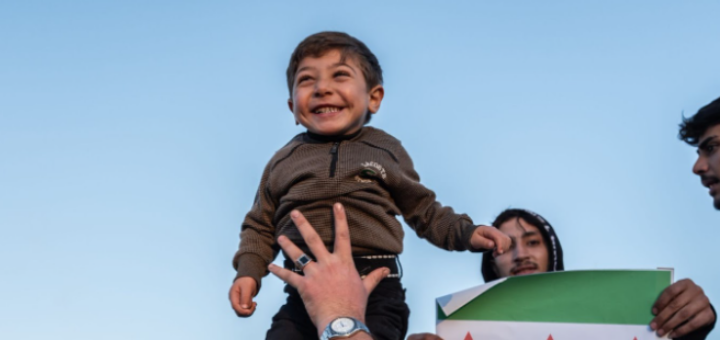
The independence flag now flies high, with the pan-Arab colours of green, white and black, featuring three red stars in the middle. As millions of refugees reclaim their besieged homes that once stood tall, as displaced Syrians reunite with their loved ones for the first time in years, and as they celebrate their freedom from half a century of dictatorship, they are well aware that they still have much to rebuild. Yet, they smile as the sun shines brightly, promising a brighter future ahead.
Amirmohammed Bagheri is a Staff Writer for The Reflector 2024-2025.