
Understanding the sport gripping MRU students
Nathan Bergen, Contributor
Rock climbing is more than someone in full gear, gripping the surface of the Canadian Rockies as they attempt to make their way up a rocky slope. Held in local recreation centres, it’s a sport that allows people to build strength and community.
The sport can be enjoyed by all, either competitively or recreationally and what makes it unique is the different courses and setups each wall consists of.
The rise of rock climbing has gotten Mount Royal University (MRU) students enthralled by the hype, such as Emma Sveistrup, who said that the amazing feeling of rock climbing led her to pursue the sport.
“Seeing the progression in real time is so rewarding, and so satisfying that it’s like an addiction. I can’t stop now,” says Sveistrup.
Indoor and outdoor climbing are vastly different from one another. Indoor climbing takes place in specialised climbing facilities, with outdoor climbing usually located in natural environments.
The history of rock climbing
Indoor rock climbing has its history rooted right in Calgary. The first institutional rock wall was built at the University of Calgary (UCalgary) ahead of the 1988 Winter Olympics as a controlled environment before athletes headed into the mountains. The university’s rock wall still stands today in the basement of their kinesiology building as a drop-in facility for UCalgary students and active living members.
Later in 1990, the first commercialized Rock Climbing wall was built in Toronto. There, Bob Bergman, an avid rock climber, along with his wife and brother, helped build ‘Joe Rockhead’s’, the first commercialised rock climbing facility in Canada.
Over the next few years, the facility would host many local and regional competitions, where it would gain a strong reputation among the rock climbing scene in North America and Europe ahead of the first-ever International Climbing and Mountaineering Federation (UIAA) Climbing World Championships in 1991.
The facility has remained open to the public for over 36 years and continues to be a building block in Canada’s rock climbing community.
Climbing benefits
While climbing comes off as a physically demanding sport, it doesn’t just benefit the body physically.
“It has benefited my mental health more than anything,” said Sveistrup. “It’s a good way to exercise; it makes you feel good about yourself; it builds confidence.”
Studies have highlighted the benefits of rock climbing. It has been proven to build endurance through consistent practice. A climber’s balance and flexibility can also improve, with results being similar to the benefits of yoga. This has not only helped climbers like Sveistrup improve their grips, but it has also helped outside of the facility.
“When I go to do other physical activities, I can feel that I’ve gotten stronger because I’ve climbed,” said Sveistrup.
Climbing today
With the growth of the sport, it has created an opportunity for climbers to get involved in competitions. Competitions such as the UIAA World Climbing Championships and World Climbing Series have three competition categories, including lead climbing, speed climbing, and bouldering.
Lead Climbing has participants climb a 12-meter wall in a six-minute time frame and get as high as they can with sections at different angles. Speed Climbing has participants on the sides of each other as they race up a 15-meter, 95-degree angled wall to ring a bell at the top. Bouldering takes place on only a four-meter-high wall at difficult angles, which has participants having to reach as many tops as possible in four minutes.
Calgary isn’t a stranger to these competitions. The city recently hosted national events, including the Senior Boulder National Championships alongside Senior Lead National Championships in February 2026. These events saw a combined 548 competitors from 9 different provinces.
There are vast differences between casual and competitive climbing, highlighted by Sviestrup, mentioning the big gap between casual climbing and those who specialise in competitions.
“They’re insanely good,” said Sviestrup. “There’s just a completely different vibe [for] people who are just doing it for fun.”
Participation in climbing
With the growth of indoor climbing, more climbing facilities have been built in Calgary, making it more accessible for new climbers to try. Sveistrup says that those who are interested in participating in the sport don’t need to fully commit right away.
“Just do a drop-in to start. Don’t just buy a membership. Make sure you like it first,” said Sveistrup. “Don’t be afraid of not doing a great job because the community is so welcoming and non-judgmental.”
Climbing requires little equipment, making it an easy and affordable activity to get involved in.
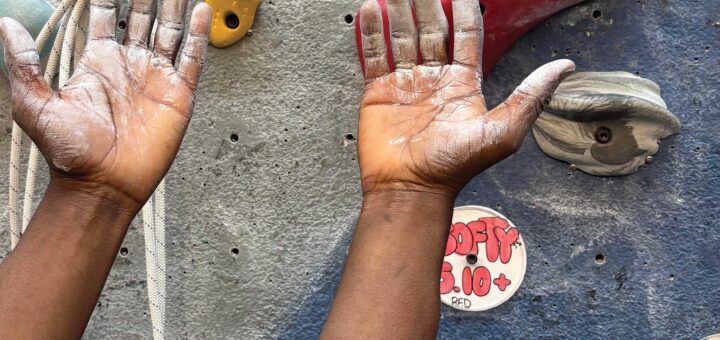
“Shoes and chalk, that’s literally all I bring,” said Sveistrup.
Different forms of climbing require different types of equipment. Most include the basics like chalk, climbing shoes, and moveable clothing. Other forms of climbing like speed climbing would require a gym rope, grigri, carabiners, and a harness if they aren’t already provided by the facility.
At MRU, the recreation centre welcomes climbers of all abilities to scale the wall and build a circle of like-minded students and community members. They help beginner climbers by providing basic starting equipment to aid their start on the wall. MRU offers climbing programs and drop-in climbing for anyone ranging from age four to seniors.