
How local venues contribute to the growing music scene
Hannah Flammenspeck, Staff Writer & Katrina Ebuenga, Staff Writer
The growing music scene in Calgary is built on community and local artists. So what does it mean when a seasoned band like Arkells chooses to play at a smaller venue like The Palomino Smokehouse?
This spring, Arkells are bypassing larger stages, choosing community music hubs as the stomping ground for their latest tour. The decision to choose more intimate venues has brought more attention to local stages in Calgary, showcasing the impact of these spaces on the industry.
Opened in 2004, The Palomino is a staple bar known for its barbecue and a centre for unique live music experiences. Located in the heart of Downtown Calgary, it is known to host and organise smaller music events that hold up to only 200 people.
Despite the lower capacity, they have hosted thousands of musical events with artists from all around the world. The smaller space has welcomed a wide variety of genres to the stage, offering an authentic experience for locals and newcomers.
First signing in 2006 with the indie label Dine Alone Records, Arkells quickly became a prominent presence in the Canadian music scene. In their upcoming tour, the band opens in their hometown of Hamilton at the 2026 Juno Awards, then scales down their capacity, headlining at small clubs and bars around North America.
The band seems to be focusing on local and historically significant venues, rather than stadiums. Locations such as Lee’s Palace in Toronto are significant venues in the Canadian music scene, known to showcase many artists at the start of their careers.
When Arkells come to Calgary on May 19, it will be the business’s most well-known artist to date, opening the possibility for other larger artists to consider more intimate venues for their concerts.
Pubs like Ship and Anchor and Dickens are also known to host small music events, which often showcase up-and-coming talent. Spotlighting the local atmosphere, music lovers are able to experience a more intimate and memorable night.

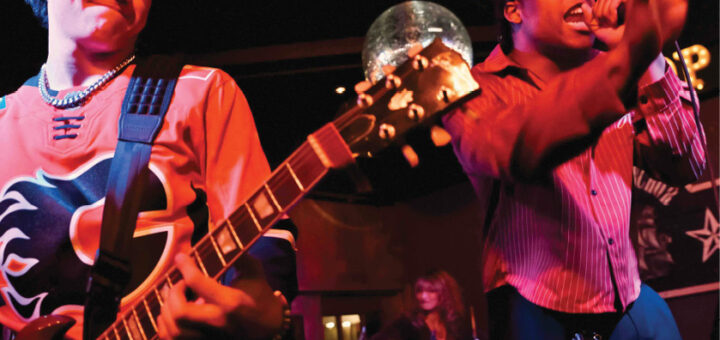
Hip-hop artist Talib Kweli playing an electric set at Calgary’s Dickens. Photo by
Shannon Johnston / @me_onlylouder
Apart from live music events, Christ Hewitt, owner of Dickens, aims to host and organise trivia, open mic nights and drag shows, branching out to diverse communities.
“I’m not particularly interested in offering only one thing to one group of people,” he says.“I definitely like to see different communities circulate through and find a little home in whatever form that may take.”
Adding to the foundation of local gathering spaces in Calgary, Dickens has become a haven for different and niche communities to come together. Hewitt cites community building as being one of the establishment’s long-standing strengths.
“There are a lot of good people out there, and a lot of them come to Dickens,” he says. ”You might find yourself a new pack, and you might find it where you least expect it.”
Supporting local businesses extends past just talking about them. K the Chosen, local artist and event host for music showcases like Ship Hop at the Ship and Anchor, explains how there is a lot more that goes into supporting businesses as an artist and organiser.
He emphasises the role of artists and industry professionals in supporting businesses not only through real purchases and engagement, but collaboration with others.
“I imagine if an artist blows up, the first thing they should be saying is, ‘this is the coffee I love to drink in the morning,’ and that helps the coffee brand get out there,” K the Chosen explains.“It gets people more excited about local businesses.”
Supporting the local businesses that host these events goes hand in hand with supporting the local music scene in Calgary. As K the Chosen expresses, going to these events as a Calgarian is extremely important for the community, encouraging it to grow.
“The fact that you’re in a much smaller space, you can really connect with the audience,” says K the Chosen, explaining how the flexibility of small venues also allows you to bend the rules and get creative with what and how you present your work.
He adds that “the bigger the venue gets, the more rules that they have.” So, while larger stages have an established brand, small businesses offer an adaptability for audiences and performers.
There is also an interconnectedness within the local venues as well, creating an ecosystem within itself.
As bigger venues look for artists, they may ask smaller venues who they recommend based on what they have seen from open mics. K the Chosen explains that this creates a pipeline for artists, where they can go from micro to small, and then to even bigger venues.
While venues like Ship and Anchor are known to host emerging artists as they get comfortable in front of a crowd, venues like Dickens are known for the diversity in their events. And with a big name like Arkells touring these micro and small venues, it highlights the importance of these spaces and their ability to foster community and grow the music scene in the city.
“Go out and try new things. That is one of the most difficult things that we have to try to express to people, because we have so many different things going on,” Hewitt says. “You never know where you might find your new home, and you never know what form it’s going to take.”