OPINION: What it’s like to live in Banff
Emma Voelpel, Staff Writer
As most young people do, I decided to spend the summer in Banff, Alta. after graduating. As with many young people, those three months quietly turned into three years.
Ever since I lived in Banff, I’ve been asking myself the same question—is it possible to live in a postcard?
A typical year there consists of summer hikes, autumnal bike rides, and hitting the slopes once the snow falls. Although, to be frank, I’m known as a nuisance on the hill, as well as a danger to myself and others.
During my time there, I learned lessons that shaped me and made self-realisations I wouldn’t have known otherwise.
Having moved there as an 18-year-old, it felt as if I was simultaneously maturing too fast, yet not fast enough.
It was my first taste of independence, yet one still surrounded by borders.
Banff is in somewhat of its own bubble. Careers and longevity are possible, but the culture has slowly shifted towards a more favourable view of short-term stints.
In terms of its resident population, the town is on the smaller side. In 2025, 11,402 people called Banff home—a 22 per cent increase since 2020. Still, its population is largely made up of people coming and going, as the town welcomes roughly four million tourists each year.
Tourism is naturally the economic driver of Banff, and it’s something the town takes very seriously. The town balances its aesthetics with commercialisation. While still acknowledging it’s a national park, it caps commercial space to only 10 per cent of the town.
Even hotels can only have a limited number of rooms to preserve nature. However, this doesn’t alleviate the foot traffic.
The fast-paced nature of summer can be addictive, with an estimated two million people visiting between July and August. The constant influx of people makes one day feel like five minutes.
I reached out to a few friends I met while living there to see if their experiences were similar to mine. Including my friend Brooke.
A bitter-sweet symphony
Brooke and I moved to Banff around the same time. At 18, moving from Ontario to Banff, she managed to balance a life of snowboarding, serving at several restaurants, and working on her degree.
“I think it mainly boils down to the overall mindset—work hard, play hard,” she says. “Most people had two jobs but wouldn’t shy away from a 10-hour hike on their day off, and it’s considered normal.”
My best friend, Sydney, was born and raised in Banff. She knows the town like the back of her hand and has always appreciated the backdrop of her childhood.
“I skied, fished, and hiked. I was incredibly lucky to be raised by parents who valued those things,” she says.
However, as she grew older, she began to notice another side to it.
“I find the culture in Banff to be incredibly unique, and one that is not unanimous,” she says. “I believe that the culture of those born in Banff versus the culture of those who live there temporarily is very different.”
The transient life in the town breeds an atmosphere that Sydney described as “the upside down.” Banff has a strong nightlife for a town of its size. Often, even getting the affectionate title of being a ‘mini-Vegas.’
Usually, after 10 p.m., bars and restaurants downtown become central social spaces for locals. Drinking is common. Drug use exists. For some, it’s occasional. For others, it becomes routine.
There’s somewhat of a pattern that starts to form. The hustle and bustle of the workday makes it feel rewarding for a drink after work—maybe even a few. This cycle is one that many people I know have fallen into.
This was, unfortunately, one of the downsides of living in such a transient, fast-paced town. It’s also one of the biggest differences compared to my way of life now. At one point, time blurred. Days and weeks began to blend together.
This is a conversation I’ve had with many of my friends who have moved out of Banff. The structure of life is completely different anywhere else, even in a city only 90 minutes away.
It’s important to mention that life doesn’t have to be that chaotic while living there. Many people manage to sustain a steady life.
Today, life consists of work, school, and being at home with my cat. The thought of being out past 10 p.m. is almost unimaginable to me now. Brooke had a similar sentiment.
“Every day is pretty much the same compared to in Banff, where there was always an adventure to conquer,” says Brooke.
I can attest that the days are much less exciting now than they were then.
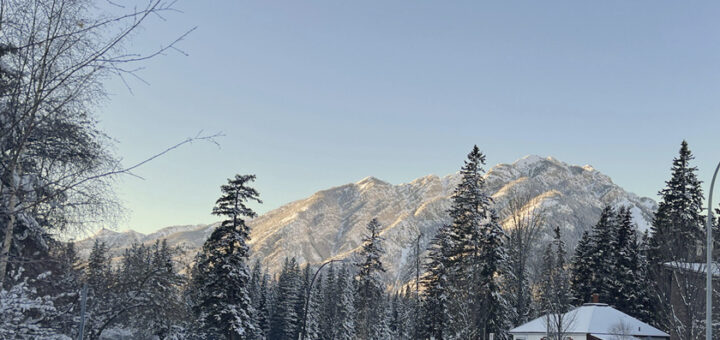
One thing that Banff has always been, despite the challenges of living there, is beautiful. To this day, I still have friends who are living there. My friend Katelyn is still astounded to have the mountains in her backyard.
“The scenery still takes my breath away,” says Katelyn. “I still have moments where I can’t believe I get to live somewhere so beautiful.”
But what I miss most about it was the people there.
Over time, you learn that the hardest part isn’t meeting new people, but letting them go.
Goodbyes became a regular part of life. Friends leave for new jobs, opportunities, or simply because their time there is up. You get used to the farewell drinks, last hikes, and promises to try to stay in touch. The constant turnover makes friendships feel intense, yet there’s always the looming reminder that they’re temporary.
One thing that makes me incredibly lucky is that many friendships have extended outside of Banff. Some of them have moved home, and some have found different paths. Some have stayed in the mountain town.