
Fact-checking comet 3I/ATLAS’s alien origins

Julia Finot, Contributor
Our solar system has experienced a rare visit from an ancient interstellar comet, and while some are interested in learning about its brief stay, others are speculating that it may have alien origins.
Somewhere beyond the sun, a large comet races around our solar system—meet 3I/ATLAS, a bright, fast, and unique look into another universe.
First spotted by the National Aeronautics and Space Administration (NASA) back in July, the 3I/ATLAS reached its closest point to the sun on Oct. 30. Though it is not believed to pose a threat to Earth, some debate that its high speed and dazzling light could be evidence of alien technology.
Specifically, Harvard astrophysicist Avi Loeb hypothesised in an article for Medium whether the comet’s significant speed and mass were consistent with terrestrial or technological material, writing that “alien technology might employ thrusters yet with higher speeds.”
However, a September study published in Earth ArXiv investigated the misconceptions surrounding the comet’s alleged extraterrestrial origins and determined that 3I/ATLAS is naturally formed.
“This study shows that the features of 3I/ATLAS are consistent with natural origin,” the study reads. “This means that Dr. Avi Loeb’s idea that 3I/ATLAS is an alien expedition is not true.”
With a large sedimentary body measuring over 11 kilometres in diameter, the comet is larger than its predecessors, but it has the chemical makeup of an interstellar object.
Interstellar, not extraterrestrial
An interstellar object is something that has appeared in our solar system from another solar system, which is what the 3I/ATLAS has been confirmed as due to its speed and direction.
There have only been two other cases where scientists have identified interstellar objects: first, back in 2017, with 1I/’Oumuamua and then in 2019 with 2I/Borisov. The 3I/ATLAS is considered to be a combination of these two phenomena, with the 2I/Borisov being an everyday comet, while the 1I/’Oumuamua barely fits this definition.
A comet has three parts—the nucleus, the coma, and the tail. The nucleus of a comet is composed of frozen rocks, dust, and gas, while the coma is the surrounding cloud of dust and gas. Together, those two things create the brightest part of the comet.
Though the 3I/ATLAS does have these characteristics, they’re slightly different from those of other comets. When it entered the solar system, it seemed to have the three parts of a comet, but recently, scientists have determined its tail has faded away. It still has a nucleus and coma, but unexpected observations of them have been made as it moves closer to Earth.
As 3I/ATLAS has travelled through the solar system, its appearance has shifted. The colour of the comet has significantly become brighter since scientists first discovered it. This, combined with its off-course travel plans, has baffled the scientific community.
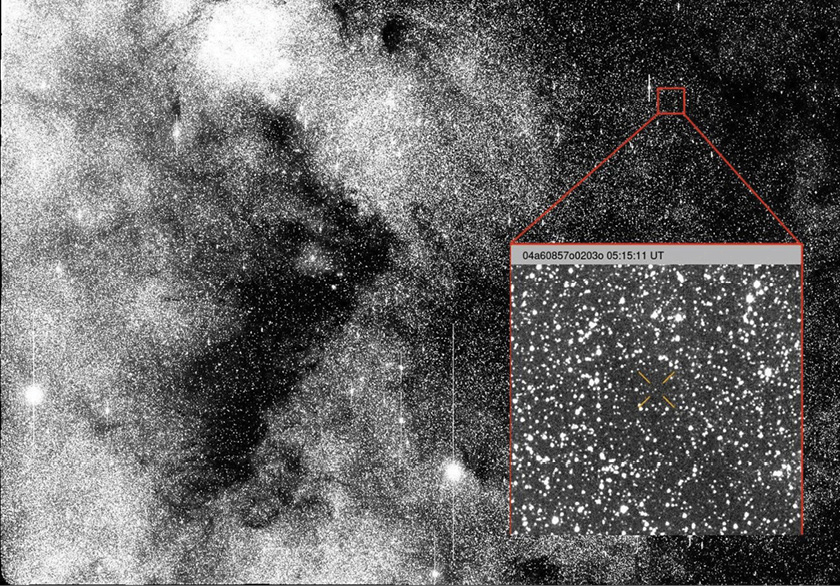
The observation of comet 3I/ATLAS when it was discovered and photographed by
ATLAS on July 1, 2025. Photo courtesy of University of Hawaii/NASA
If not alien, then why alien-shaped?
Between its makeup and trajectory, it is believed that the 3I/ATLAS originated from the Milky Way’s thick disk. This area is outside our solar system, but it is believed to be home to stars older than 13 billion years, which suggests that the comet may be misbehaving due to its ancient origins.
A report by astronomers at the South African Radio Astronomy Observatory (a major observatory in Cape Town) revealed their telescope picked up a radio signal from 3I/ATLAS. This wasn’t a communication-based radio signal, but rather a signal detecting hydroxyl radicals. In short, it is one of the most potent oxidising agents commonly found in the nucleus of a comet, which is not believed to be released from alien technology.
Another misconception is that the comet is a threat to humanity. NASA has confirmed that 3I/ATLAS will have no impact on Earth. The closest it will get to us will be about 270 million kilometres, which is farther than the sun is from Earth. Theoretically, it would take around 200 days to reach the comet via a space shuttle.
The 3I/ATLAS started its journey behind the sun in late October and will not be visible to scientists again until late 2025, when it returns close to Earth on Dec. 19.
Whether it is a piece of history from another solar system or an eye-opener to what lies beyond us, the comet serves as a reminder to everyone of how much of the universe we have yet to explore.