
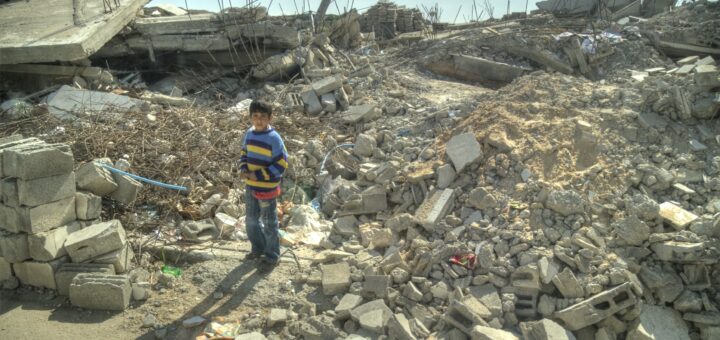
Two years and counting of destruction in Gaza
Bella Coco, News Editor & Abiola Famakinwa, Contributor
Two years after the Oct. 7, 2023, Hamas attack and the subsequent full-scale Israeli military campaign in Gaza, the conflict between Israel and the Palestinians remains among the most consequential and contested of the 21st century.
Allegations of genocide, international legal proceedings, repeated ceasefire failures, and a worsening humanitarian crisis have characterized the past two years.
The following timeline outlines key developments from the onset of hostilities to the latest ceasefire initiatives.
Oct. 7, 2023
- Hamas launches a large-scale attack on southern Israel, killing over 1,200 people and abducting 251 hostages, according to Israeli and international sources.
Oct. 8–10, 2023
- Israel responds by naming its campaign Operation Swords of Iron, imposing a “total blockade” of Gaza—cutting food, fuel, and electricity—and launching heavy airstrikes.
- The blockade intensifies, further deteriorating humanitarian conditions in Gaza.
Oct. 27, 2023
- Israel initiates a ground invasion of Gaza, saying it seeks to dismantle Hamas’s command structure and liberate hostages.
Late 2023 – Early 2024
- Gaza’s hospitals and infrastructure suffer extensive damage as the campaign continues.
- Reports document the discovery of mass graves, attacks on civilians displaying white flags, and widespread forced displacement.
- In February 2024, Israeli forces fired on Palestinians waiting for food aid, resulting in over 100 deaths in an incident referred to by some sources as the ‘flour massacre.’
- South Africa formally files a case against Israel at the International Court of Justice (ICJ), accusing them of genocide.
- On Jan. 26, 2024, and March 2024, the ICJ orders provisional measures requiring Israel to prevent genocide, allow humanitarian aid, and halt military operations causing famine.
- In December 2024, Amnesty International concluded that there is a sufficient basis to say Israel is committing genocide in Gaza.
2024 (Mid-year onward)
- Humanitarian conditions worsen as famine is officially declared in parts of Gaza and essential services collapse.
- Israel’s military operations shift progressively southward as northern Gaza becomes largely depopulated or destroyed.
- Multiple ceasefire attempts and negotiations for hostage-prisoner exchanges are undertaken but repeatedly fail.
- In May 2025, multiple protestors set up encampments on the University of Calgary (UofC) campus in support of Palestine, resulting in tension and incidents with the Calgary Police Service (CPS).
- International scrutiny increases. In 2025, the United Nations Human Rights Council establishes an Independent International Commission of Inquiry, which in September 2025 formally concludes that Israel is committing genocide in Gaza.
Jan. 19, 2025
- A ceasefire deal comes into effect, with the agreement that both sides would release hostages. Humanitarian aid was allowed into Gaza.
March 18, 2025
- Israeli Prime Minister Benjamin Netanyahu proposed phase two, with amended terms, and when this was rejected, Israel stopped allowing aid into Palestine, launching Operation Might and Sword
- Soon after, 600 Palestinians were killed in Gaza, and Netanyahu says “Israel will, from now on, act against Hamas with increasing military strength.”
2025 (Mid-year onward)
- Israeli forces killed a 14-year-old Palestinian boy for throwing rocks at a highway in Bethlehem.
- A survey by the Pew Research Center showed that in 20 of the 24 countries, at least half of the adult population expresses a negative view of Israel.
- On May 7 the UN says that the US has to intervene or “bear witness to the annihilation of the Palestinian population in Gaza,” as a result of the growing death toll.
- At the end of May, there were mass protests against Netanyahu across Israel
- In June, the Madleen departed from Sicily in an effort to deliver aid to Gaza—they were intercepted on June 9 by Israeli forces and taken to Israel.
- The UN General Assembly overwhelmingly voted in favour of a permanent ceasefire in Gaza.
- In July, Israel ordered the evacuation of Khan Younis, saying people should move to Muwasi, a safe-zone established by the Israeli army, which is now a crowded camp.
- In late August the Global Sumud Flotilla—with boats with passengers from Sweden—the United States, Turkey, and 41 other countries, began their journey to Gaza to deliver aid.
Sept.16, 2025
- A UN commission reports that Israel is committing a genocide in Gaza.
October 2025
From Oct. 1-3, the Flotilla was intercepted by the Israeli navy, with many members being taken to Israel, including political activist Greta Thunberg, the former mayor of Barcelona Ada Colau, and grandson of Nelson Mandela, Mandla Mandela.
- Some are still unaccounted for, having either been arrested or considered missing, including actors Kaba Assefa and Susan Sarrandon.
As of Oct. 7, 2025, 67, 173 Palestinians have been killed, 30 per cent of the total being children. At least 248 journalists have been killed in Gaza, more than in any other modern conflict, including World War I and World War II.
This story cites events regarding the genocide of the Gaza strip from Oct. 7, 2023, to Oct. 15, 2025.