
OPINION: Israel’s war on Gaza the deadliest in journalism history
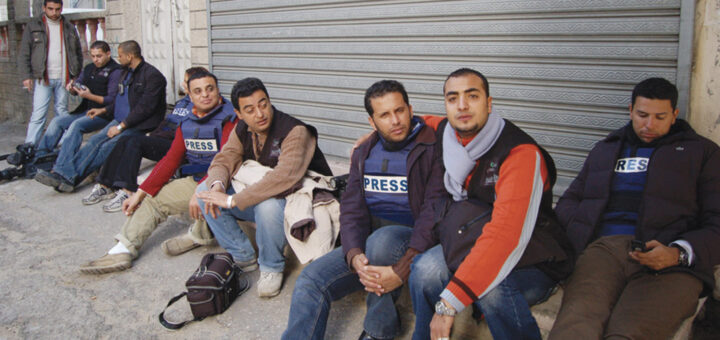
Ryan Montgomery, Contributor
For 23 long months, since the attacks of Oct. 7, 2023, the Israeli Defence Force (IDF) has been invading Gaza, bringing immeasurable havoc and damage to the Strip. In a war so one-sided, where one nation holds uncontested military dominance over the other, the IDF can attack with impunity.
One defence for the unarmed is the arena of public opinion and the journalists who fight in it, which is why this fact is so alarming to face: for journalists, this conflict is the deadliest in the history of documented war correspondence.
On Aug. 25, the IDF attacked Nasser Hospital in Khan Yunis, the second largest city in the Gaza Strip. According to the Associated Press, the IDF struck the hospital using high-explosive tank rounds and did so without warning. The attack killed 22 people, including relatives of the patients, healthcare workers, rescue workers, and four journalists. A well-known gathering spot for journalists, the hospital was targeted by the IDF because they believed it harboured “suspicious behaviour.”
The behaviour in question, as explained by Israeli officials, was a camera perched on the roof of the hospital—what the IDF thought was being used by Hamas for intelligence gathering.
In short, they saw a camera, shot at the hospital with a tank, and killed 22 innocent people. It seems the “best trained military” in the Middle East has a hard time distinguishing between a camera and a rifle.
Israeli Prime Minister Benjamin Netanyahu referred to the event as a “tragic mishap.” However, to call this incident a “mishap” downplays the staggering regularity of attacks like this in Gaza.
War correspondents—journalists sent to warzones to observe and report on conflict—have been killed at a staggering rate unseen in any other conflict in modern history. According to the International Federation of Journalists, as of Sept. 4, at least 221 journalists are confirmed as having been killed while reporting in Gaza, a number that Al Jazeera—a Qatar-based news organization—places even higher at 278.
So, how does this number compare to past wars? The Watson Institute for International & Public Affairs at Brown University lists the death counts of previous wars as such: 69 in both the First and Second World Wars, 17 in the Korean War, and 71 in the Vietnam War. Altogether, the number sits at 157 total deaths, which is approximately 64 fewer than in Gaza.
Perhaps the wars of yore are a poor comparison, or that the nature of journalism has changed in this century, and that there are significantly more journalists per capita, and thus, many more will be killed. To determine if this is the case, we can compare this to other conflicts in the information age, namely the ongoing Russo-Ukrainian war.
The three-year-long conflict between the two largest European countries has a colossal front line of nearly 2,000 kilometres, which has seen over two million soldiers in action. That number is almost identical to the total sum of casualties, not to mention the 10 million civilians who have fled and been displaced.
How many journalists have been killed in this titanic war? According to Reporters Without Borders, 13, which is just under six per cent of the total confirmed in Gaza.
So if modern warfare isn’t our answer for why so many journalists have been killed in Gaza, is it possible that Israel’s presence or policies have led to a higher death count?
Israel banned international journalists from covering the war in Gaza, which has led to news organizations relying almost entirely on local Palestinian residents and members of the media to provide information on the war. This has prompted Israel to repeatedly claim that Palestinian journalists are members of Hamas and, therefore, are active combatants and can be bombed fair and square.
On Aug. 10, Israel bombed a media tent outside of Al-Shifa Hospital in Gaza City, killing seven people—six of whom were journalists. Israel claimed, without evidence, that one of the journalists killed, an Al Jazeera correspondent named Anas al-Sharif, was leading a Hamas cell and was working to attack Israeli soldiers and civilians. Last year, the IDF made the same claim, stating that six Al Jazeera reporters were Hamas operatives. Once again, without concrete evidence.
According to Gaza’s Ministry of Health, Israel has killed at least 63,459 Palestinians as of Sept. 1. However, due to the IDF’s destruction having impacted the ministry’s operations, the number is believed to be significantly higher. Data from the United Nations shows that nearly 70 per cent of civilians killed in the war in Gaza are made up of women and children.
After the aforementioned Khan Yunis hospital bombing, Reuters—one of the largest international news organizations—announced that it will no longer be sharing the locations of its journalists working from the Gaza Strip to the IDF.
News agencies sharing the location of their reporters with both sides in a conflict has long been standard practice in modern war. The killing of journalists in wartime is explicitly listed as a war crime under the Geneva Conventions. Because of this, there is a long-held assumption on the part of the journalists and the militaries involved that combatants will not target an area known to have journalists in it. Hence, sharing their location keeps them safe.
For Reuters to cease this practice means one of two things: either the IDF is so incompetent in not targeting journalists that Reuters feels they are safer if the IDF doesn’t know their location, or the IDF is explicitly targeting journalists in the Gaza Strip.