How we can remember WWI
Aiden Johner, Photo Editor
With Remembrance Day approaching on Nov. 11, it is important to look back and remember those who have fought for our country.
I want to highlight some of the lesser-known records from the First World War which remain one of the biggest reasons we are able to remember it in the way we do today.
At the start of the First World War, soldiers were allowed to carry cameras. However, in 1915, Great Britain stopped allowing this for security reasons, which stayed true until April of 1916.
During this time, Max Aitken started the war art program as a way of capturing what the war looked like. Max Aitken was a millionaire entrepreneur who left Canada in 1910 to go to Great Britain.
It was there that he was knighted as a member of parliament, and began purchasing newspapers. By 1915, he was known formally as Lord Beaverbrook.
With the war starting in 1914, Lord Beaverbrook went back to Canada, where he would begin covering the Canadians in the war via newspaper. In 1916, Beaverbrook convinced the Canadian War Office to allow official photographers and videographers to accompany forces on the front lines. Beaverbrook, who at the time was head of the Canadian War Records Office (CWRO), founded The Canadian War Memorial Fund (CWMF).
The CWMF commissioned painters to paint scenes from the First World War. This fund would eventually employ close to 120 artists from Great Britain and Canada, who together created nearly 1,000 works.
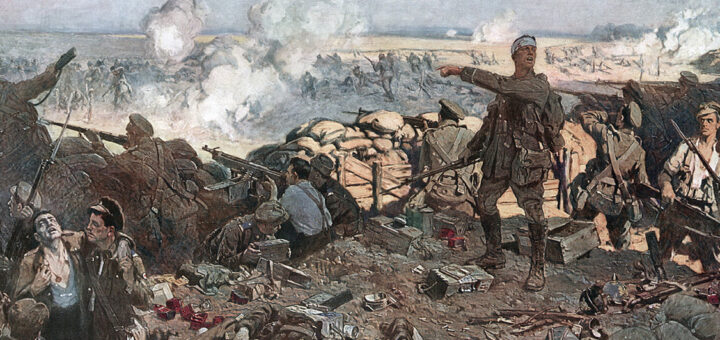
The first of these commissioned artists was English-Canadian Richard Jack. He was commissioned to paint the now famous painting, The Second Battle of Ypres, 22 April to 25 May 1915. This painting is currently on display at the Canadian War Museum in Ottawa.
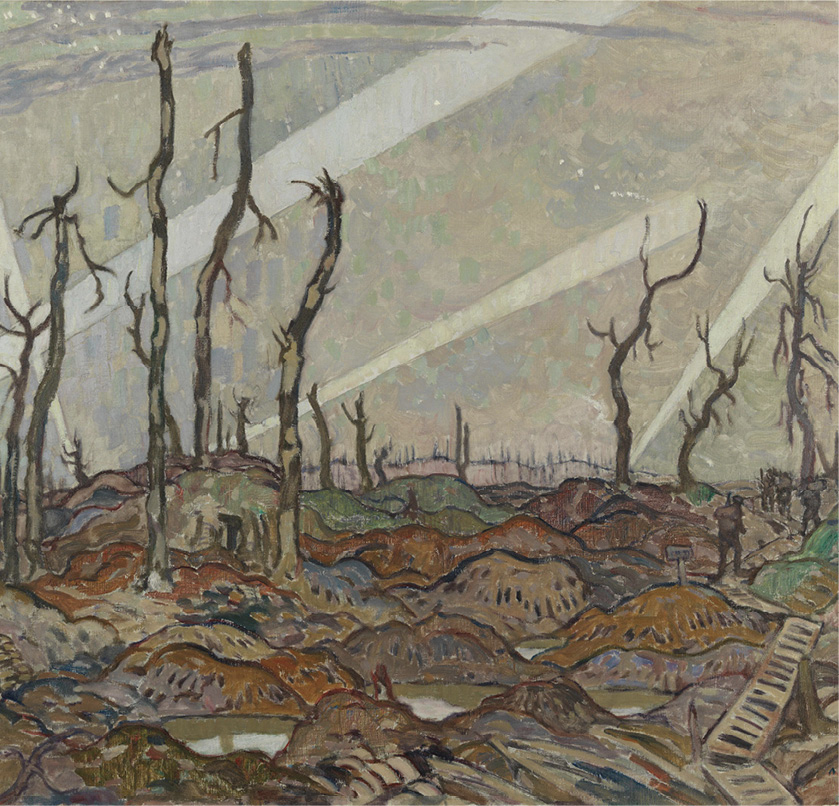
A Copse Evening, 1918. Painting by A.Y. Jackson, Courtesy of the Canadian War Museum, Via Wikimedia Commons.
The CWMF continued commissioning artists to paint art coinciding with the war. Although few of these artists served on the front lines, their paintings were created with first-hand accounts of the conflict, allowing people to see what went on during the First World War.
A.Y. Jackson, another military artist with CWMF, was one of few who had served on the front lines before joining the fund. One of his most famous paintings, A Copse Evening, 1918, depicts a landscape affected by the catastrophic effects of the First World War.
If it weren’t for Lord Beaverbrook and his push to have the First World War documented to the extent that it was, and the artists, photographers, and videographers who worked to show what the war looked like, we may not be able to remember it as we do today.
The fact that we have legal photographs and videos, along with commissioned paintings, allows us to remember one of the most horrific times humanity has seen—it provides a better understanding of the past, as well as the enduring struggles of soldiers and families alike.
The First World war ended 107 years ago on Nov. 11, 1918. No one alive today fought in this battle, which is why it’s so important that these paintings exist.
During some of the worst times in human history, there have been artists sent to capture the moments—some through photography, and some through paint. They all help us to remember.