
The history of the Palestinian Genocide
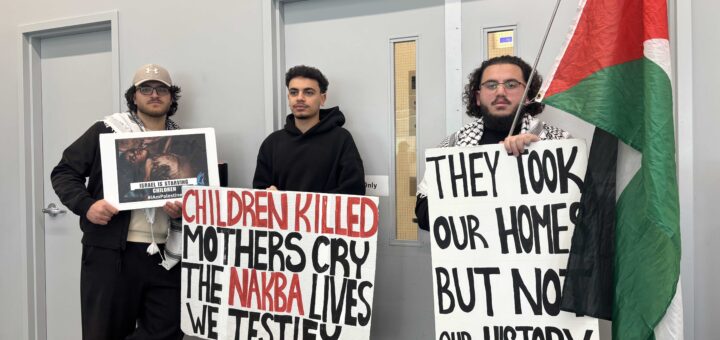
Anais Loeppky, Web Editor
In the last three years since the Oct. 7 attacks, the world’s eyes have been on Israel and Palestine. However, conflict between the two countries started long before the initial Hamas invasion.
How it began
Israel officially became a country in 1948, shortly after the end of World War II. In 1947, the United Nations General Assembly adopted Resolution 181, which proposed partitioning Mandatory Palestine into separate Jewish and Arab states.
This led to a civil war in Palestine. When the regional war ended in 1949, Israel controlled 77 per cent of the territory of Palestine. More than 700,000 Palestinians were displaced from their homes. Many of these displaced people ended up in the narrow, 140-square-mile area we now know as the Gaza Strip.
The Gaza Strip was then placed under Egyptian military administration. Palestinian refugees became trapped there due to Egypt’s refusal of citizenship and Israel’s decline of reentry to their homes.
Occupation and the blockade
In 1967, the Six-Day War took place, during which Israel captured the Gaza Strip from Egypt. Israel placed Gaza under military rule and began constructing settlements within the territory.
This continued until 2005, when Israel withdrew its troops and dismantled its 21 settlements inside the Gaza Strip.
In 2006, Hamas won the Palestinian legislative elections and therefore took administrative control of Gaza. In response to Hamas taking power, Israel and Egypt imposed a strict land, air and sea blockade. Israel justified the blockade as a necessary security measure to prevent Hamas from acquiring weapons, while international bodies and human rights organisations heavily criticised it, often describing the locked-down territory as an ‘open-air prison.’
Modern conflict
On Oct. 7, 2023, Hamas and other armed groups launched an attack on southern Israel, entering more than 20 communities and killing people in their homes. One of the hardest-hit locations was the Nova Music Festival, where more than 350 young people were killed while trying to escape. The attacks also resulted in 251 people being taken hostage and brought to Gaza.
An estimated 1,200 people were killed that day in Israel. The events left families and communities devastated and marked a turning point in the conflict.
These attacks prompted the beginning of what the United Nations has confirmed to be a genocide. Since that day, Israel has killed more than 74,000 Palestinians.
Continually deteriorating living conditions in Gaza have also contributed to a declining life expectancy, with the median age in Palestine being approximately 20 years old, compared to 42 in Canada.
Following the Oct. 7 attacks, Israel began a full siege of Gaza, restricting access to electricity, fuel, food and water. Israel then ordered more than a million Palestinians in northern Gaza to evacuate their homes and head south as intense bombings began.
In November 2023, Israeli forces entered Gaza’s largest hospital, Al-Shifa. This was one of the many incidents that raised serious concerns about potential violations of international humanitarian law.
In February 2024, more than 100 Palestinians were reported killed as crowds gathered around an aid convoy in Gaza City.
In May 2024, Israeli forces expanded their operations into Rafah, where large numbers of displaced Palestinians had sought shelter. Evacuation orders forced many people to flee.
Ceasefires
A ceasefire began on Jan. 19, 2025, allowing hostage and prisoner exchanges and increased humanitarian aid. It broke down in March, when Israel resumed large-scale military operations and once again blocked aid from entering Gaza.
In 2025, famine and starvation also became central concerns. Severe food shortages, displacement and restrictions on humanitarian assistance pushed Gaza into worse conditions. In August, famine was confirmed in Gaza Governorate by the Integrated Food Security Phase Classification (IPC).
In 2026, the genocide is still going on. More than 74,000 Palestinians have been reported killed. An estimated 10,000 people remain trapped beneath the rubble, and an estimated 60–70 per cent of the victims are women and children.


