
Staring at the sun: Astronomy outside the classroom
Karra Smith, News Editor
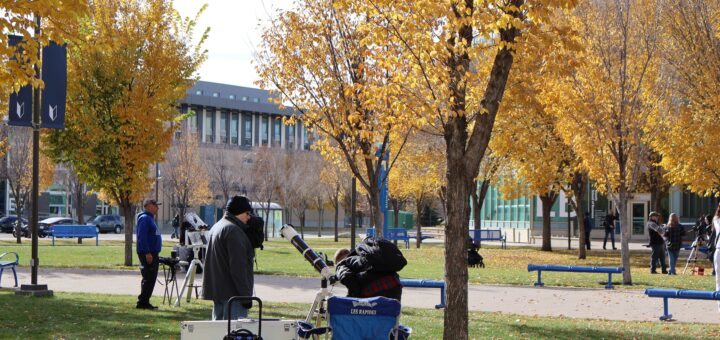
It’s not very often people are encouraged to look at the sun, let alone with a magnification device, but that is exactly what MRU students on the East Gate lawn were invited to do on Oct. 8.
The 2026 Sustainability Fair took place on campus from Oct. 5 to 9, and one of the booths set up to educate about our world and the cosmos was the astronomy class booth.
Stephen Jeans is a professor of Earth and space sciences at MRU and a member of the Royal Astronomical Society of Canada (RASC). Jeans serves as the coordinator for this sun-gazing event, as well as several other space-focused opportunities both on and off campus.
With the help of student volunteers, professors from the department of chemistry and physics and astronomers from the RASC, clear conditions on Oct. 8 gave campus goers the opportunity to look at sunspots.
This is a phenomenon that Jeans describes as “acne” for the sun, where magnetic loops on the sun’s surface are wound up as the sun spins and pop out, leaving temporary dark spots visible to the human eye with the correct telescope.
Jeans says that over the next few years, these blemishes will be less visible or numerous than they’ve been previously, as the Sun moves out of its 11-year cycle—which is exactly why he took this opportunity to show off the spots to more than just astronomy students.
“Why not show everybody, some of the future students, and some who might not even take science or astronomy, so that they can get a little experience of what nature’s all about, and help to connect them better with nature and understand the world around them,” Jeans says.
For Jeans, hosting this demonstration during the Sustainability Fair also provided a chance to educate people about using space in a way that does not harm astronomy, “as opposed to causing damage wherever we go.”
Jeans added that these events also could not take place without the help of the MRU community, including assistance from the Facility Management team, MRU Communications and parking services.
By taking the learning beyond the classroom, Jeans has reignited one student’s passion for space and the galaxy.
Growing up, Graeme Ellis–a journalism student at MRU–would frequently borrow his mom’s telescope and became fascinated with astrophotography—but he slowly fell out of this passion as he grew older.
While he was previously familiar with RASC, Ellis was drawn back to his love of space after taking a class with Jeans and learning about the professor’s role within the RASC.
Ellis says that by learning in a more hands-on, practical manner, people are becoming more motivated to study astronomy and our solar system.
“It’s one thing to see pictures of the sun or of Saturn.. But when you actually see it with your bare eyes or just through a telescope, it’s like this almost surreal experience,” says Ellis.
“It’s literally a new way of seeing the world that we live in.”
What’s next?
Sun-spotting is far from the only on-campus opportunity to gaze into space.
On Oct. 22 from 6:30 to 8:30 p.m., the astronomy sections are hosting a Star Party at the East Gate Parkade. Attendees will be able to view the moon, Saturn and stars alongside Jeans and other RASC astronomers.
The event is free to attend and open to the public, with parking available in the lower levels of the parkade after registration.
Jeans will also be speaking at the Telus Sparks Centre on Oct. 24.
*Jeans also added that these events could not take place without the assistance of the Facility Management team, MRU Communications, as well as parking services.
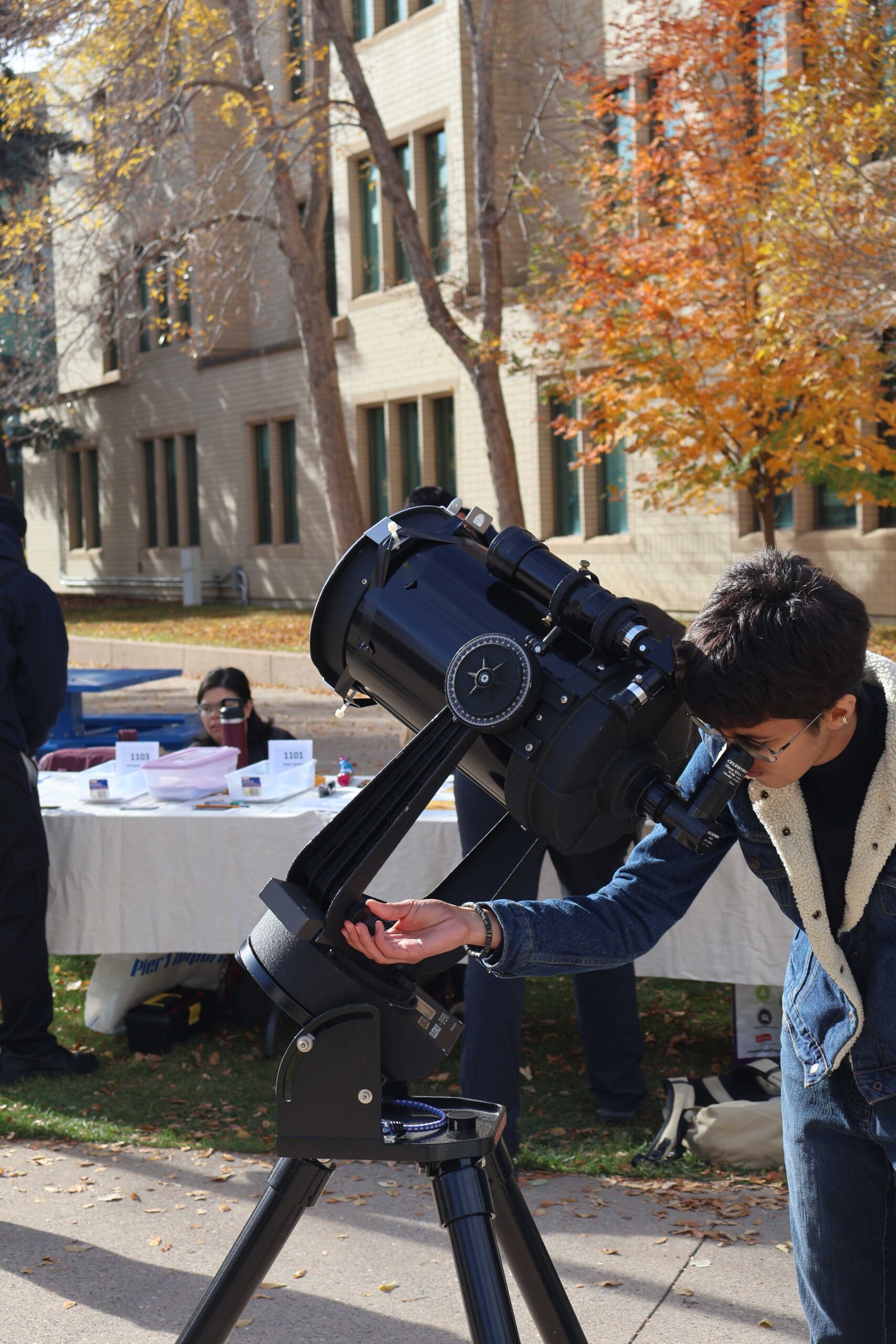
Scientists use sunspots to track the sun’s position within
it’s 11-year cycle. Photo by Karra Smith


