
Calgary’s Saddledome demolition debate continues as Scotia Place construction advances
Julia Finot, Staff Writer
As the end of the NHL season quickly approaches, one thing hangs over the minds of Calgarians: the planned demolition of the Scotiabank Saddledome.
The 2026-27 hockey season will be the last opportunity for people to enjoy the arena.
The Saddledome is one of the most recognisable buildings in professional sports, but the city says its replacement is necessary for Calgary’s growth.
“It’s much more about an investment that the city is making in that district than it is about the operators of an NHL team,” said Calgary’s Chief Administrative Officer David Duckworth in an interview with CBC. “It’s really about building community.”
For many, the closure of the Saddledome is more than just the loss of a venue; it also makes the disappearance of a symbol closely intertwined with Calgary’s identity.
The Dome opened in 1983, originally constructed for the 1988 Winter Olympics. Not only has the arena been used for sports, but it also hosted conventions, concerts and even a royal visit from Queen Elizabeth II.
Its saddle-shaped roof has been anchoring Calgary’s skyline for four decades, but despite its iconic history, it is the second-oldest arena in the NHL. With Calgary’s downtown revitalisation plan, the city is looking to take bold action in modernising the city’s centre to fit the needs of Calgarians.
A building from another era
The Saddledome was designed in the late 1970s by Barry Graham, who modelled the Dome after the Scandinavium arena in Gothenburg, Sweden.
Its design reflects an old generation of sports infrastructure. With ageing mechanical systems, narrow concourses and limited luxury seating and services, the building is considered by some to be a production constraint, and has raised questions about its long-term viability in a growing city.
Modern arenas surpass the Dome in functionality. They are now multi-use entertainment hubs with exceptional hospitality services, technology, and event spaces. Renovating the Dome to those standards would be costly and complex.
“It’s 40-years-old,” said Duckworth. “Either [it] needs to be replaced, or it needs hundreds of millions of dollars in upgrades.”
The saddle roof structure is one of the most complicated aspects for the possibility of renovations, with its shape limiting the opportunity to significantly improve the interior of the arena.
This has led the city to support replacement rather than redevelopment, framing it as a practical step.
Public pushback
Unfortunately, even with the city’s green light, Calgarians are unhappy with the plans to demolish the Dome.
The new arena deal is currently valued at over $1.2 billion, with a major portion of the funding coming provincially, which is pulled from taxpayer dollars.
Critics argue that taxpayers should not fund the majority of the arena development costs, particularly when the facility will be home to numerous professional sports organisations.
“Taxpayers shouldn’t be the ones footing the bills to build these new arenas for the players to play in and for the owners to kick back in their corporate boxes,” said Kris Sims, director of The Canadian Taxpayers Federation, in a statement to City News.
Petitions and social groups are advocating to “Save Our Saddledome”. The hope is to have the arena repurposed rather than removed.
Calgarians have suggested turning the Saddledome into a community recreation facility or an improved multi-functional entertainment venue.

Despite the city greenlighting its demolition, Calgarians
continue to rally to save the Saddledome. Photo
courtesy of Landen Melnick
Construction as the next chapter
While the debate continues, the construction of a new arena has been well underway.
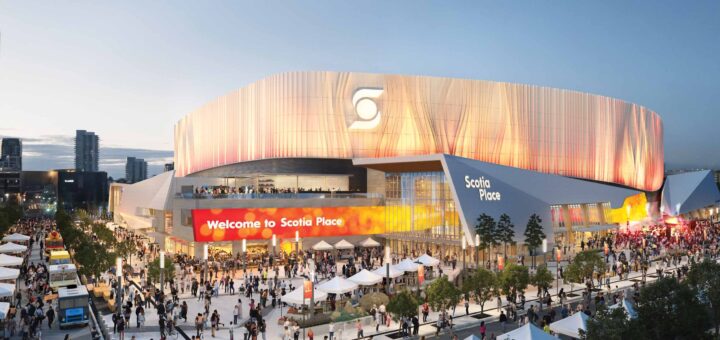
Calgary’s new arena, Scotia Place, is set to replace the Saddledome by fall 2027. It will increase Calgary’s arena seating capacity while also attracting new entertainment opportunities.
Scotia Place has a new innovative design to maximise its use. During sporting events, the arena will hold 18,400 spectator seats and up to 20,000 for concerts. It will also feature a 1,000-seat community rink.
It has been designed with accessibility at the forefront. There will be quiet rooms, accessible concourses, and seating, as well as flex washrooms.
Scotia Place is also designed to be a net-zero facility by 2050, featuring solar panels, district heating, and high-efficiency cooling.
“When you consider that Calgary is already the envy of other cities with a new world-class convention centre in the heart of the Culture and Entertainment District, the addition of Scotia Place is another signal to investors that our city understands how to build a future that leverages hospitality and hosting as its core strengths,” said former Calgary mayor Jyoti Gondek.
Scotia Place will be the home to many Calgary sports teams, including the Flames, Wranglers, Hitmen and Roughnecks.
The arena is a highlight of the city’s entertainment district, and it is set to expand on live amenities and attract large-scale events that Calgary has previously missed out on.
Legacy
As Calgarians await demolition, the Saddledome’s final months are unfolding right next to the building set to fully replace the iconic Calgary landmark.
For some, the construction of Scotia Place next to the Dome is a symbol of closure. It’s an opportunity to celebrate the legacy of the building and all the events it proudly hosted. For others, it reflects Calgary’s development as a growing city adapting to new infrastructure.
Whether remembered as an iconic landmark or a stepping stone in Calgary’s downtown revitalisation plan, the Saddledome’s departure will mark the end of an era that not only shaped Calgary’s sports scene but also shaped Calgary’s cultural landscape for the last 43 years.


