OPINION: Curbing lions uproar: Mullahs’ slaughter of Iran
Vlad Semeshko, Staff Writer
For decades, the true nature of Iran and its people has been obscured by misconception and propaganda. While the Islamic regime in control of the Iranian government presents itself as the voice of the nation, the reality is that it heavily relies on ruthless repression and fear to maintain power.
Independent estimates of the religious makeup of Iran show that approximately 32.2 per cent of its population is Shi’ite Muslim. When combined with the five per cent of Sunni Muslims, the religious followers only constitute a marginally larger share than secular segments of Iranian society.
Despite representing only a plurality of Iran’s population, the Islamic regime imposes one of the most extreme interpretations of sharia law in the region on a non-Muslim majority. In terms of state brutality, it is often compared only to Taliban-ruled Afghanistan.
Through the stories of Iranian women defying gender-based violence, compulsory hijab laws and their deaths that followed their activism, the world occasionally caught a glimpse of the day-to-day reality of Iranians and their ongoing struggle with the brutality imposed by their government.
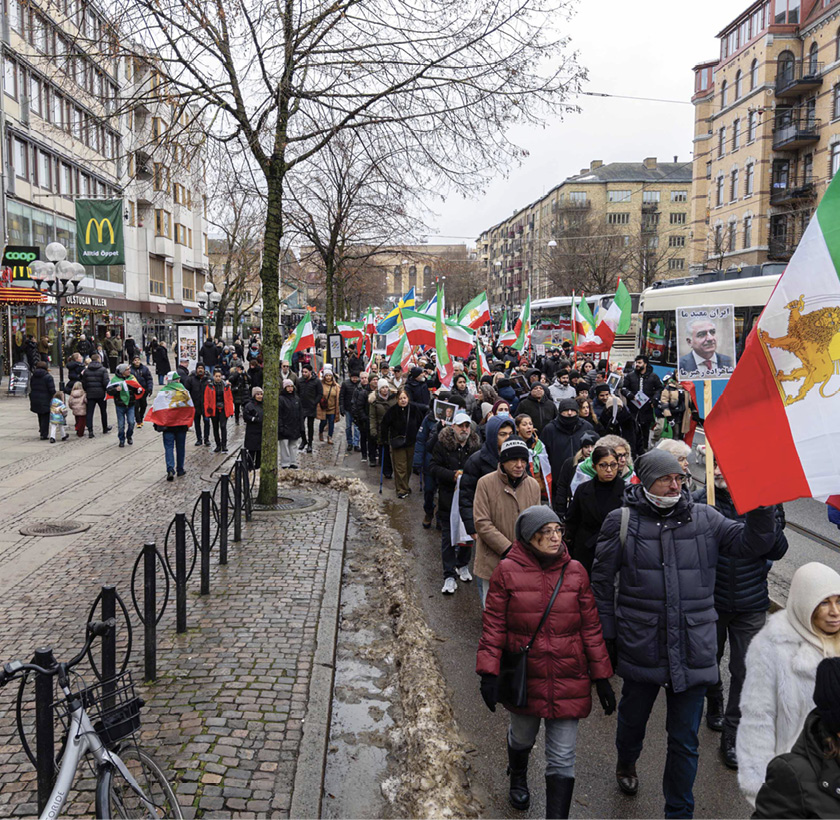
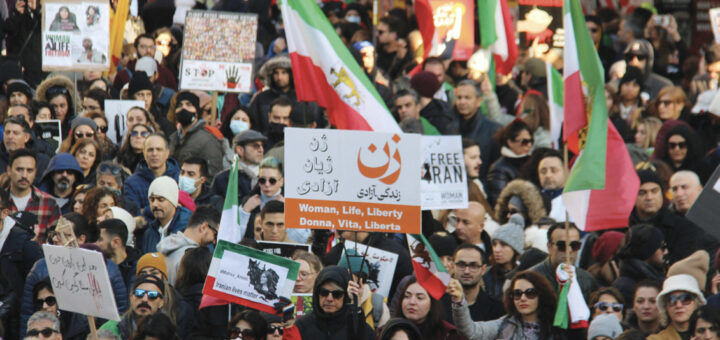
Demonstrators against the Iranian regime march in Gothemberg, Sweden. Photo courtesy of Crannofonix News via Wikimedia Commons
Supreme Leader of Iran, Ali Khamenei, presents the regime’s repressive actions as righteous through religious fundamentalism, grounding its most recent slaughter of thousands of protestors in the violent and revolutionary founding of the regime itself.
“Everyone knows the Islamic Republic came to power with the blood of hundreds of thousands of honourable people; it will not back down in the face of saboteurs,” Khamenei said in response to U.S. President Donald Trump’s recent calls on Iranians to continue the demonstrations and seize control of their institutions.
The internet blackout imposed by the Islamic regime is intended to conceal the scale of the massacres carried out by the state and limit communication both within its borders and with the outside world.
With very limited ability to reach their friends and families, Iranians living abroad are left to speak on behalf of their friends and family members who are firsthand witnesses to the human rights violations of the regime.
Recently, Iran has aired 97 coerced confessions on state television as proof of the state’s claim to the narrative of a foreign plot fueling the riots. Human rights groups and former detainees say the statements are coerced under duress or torture, serving to legitimise mass arrests amid ongoing internet blackouts.
Iranian authorities have since warned that punishment is “only just beginning” for those detained, signalling expedited trials, harsher sentences, and expanded asset seizures. Officials have framed the crackdown as a matter of national security, reinforcing claims of foreign interference.
Following a streak of strategic setbacks in the region, including defeats of Hezbollah in Lebanon, Hamas in Gaza, and the fall of Assad’s regime in Syria, the Islamic Republic of Iran finds itself increasingly isolated and vulnerable against its geopolitical adversaries.
Israeli and American actions in the region do not stem from genuine concern for the people living under these regimes. This is demonstrated by Israel’s aggressive incursions into Lebanon and Syria, as well as the bombing of civilian centres in Tehran, the Iranian capital, during the 12-day war in June 2025.
As internal resistance continues to grow and regional influence erodes, the gap between the state and its people becomes increasingly unsustainable. While external powers pursue their own strategic interests and point to the possibility of regime change, the reality remains unchanged: Iran’s future will ultimately be decided by its people, not by the regime that seeks to silence them.