Inside the NDP’s first leadership debate
Sophie Botheras, Contributor
After the 2025 general election left the NDP at a meagre seven seats in the House of Commons and saw them lose official party status, a bruised party seems in dire straits — but now, they’re looking to rebuild.
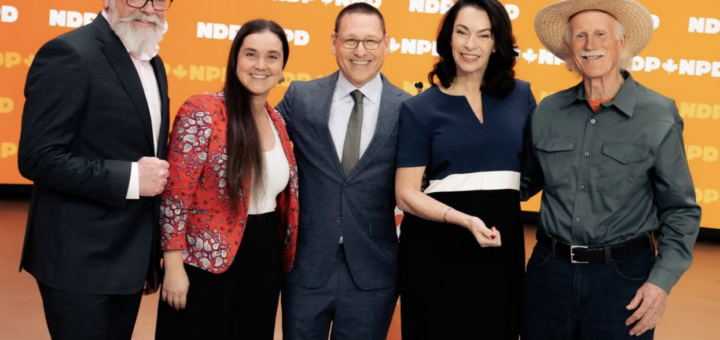
As such, five candidates brought their visions for its future to the stage at the NDP’s first leadership debate.
The bilingual debate took place in Montréal on Nov. 27 and saw Rob Ashton, Tanille Johnston, Avi Lewis, Tony McQuail and Heather McPherson, the only candidate with a seat in Parliament, each highlight their greatest concerns and goals for the party.
Rob Ashton
Ashton, a dock worker and union president who is fighting what he calls a “class war,” took most of his allotted time to discuss his commitment to the working class and his goals of reclaiming the NDP for the 99 per cent.
“We’re gonna take all the power from the CEOs that we can take from them,” says Ashton. “Because all the power belongs to workers.”
His proposed solutions to the affordability and housing crises include caps on necessities, guaranteed jobs programs and public housing investment. Ashton claims that the party “must go back to [their] roots” by meeting with working people and representing their voices, including Québecois and Indigenous Peoples.
Tanille Johnston
Johnston, a social worker and Campbell River, B.C. city councillor, has focused her campaign on grassroots organising and leftist policy.
A Liǧʷiłdax̌ʷ woman from the We Wai Kai First Nation, Johnston had the most to say on Indigenous justice, claiming that the federal government needs to “stop paternalism towards First Nations,” and that they must see them for the governments that they are.
She’s campaigned on transparent discussion between the federal NDP and riding associations, alongside affordability promises such as free post-secondary education, a guaranteed livable basic income and the breakdown of interprovincial trade barriers for food.
“It was great to see other barriers broken down between provinces, but they left food behind. We need our food,” Johnston says.
Avi Lewis
Lewis, son and grandson of major NDP figures Stephen and David Lewis, respectively, has built his platform on climate action and deep federal investment in the public sector, proposing a “Green New Deal.”
“Public is not a dirty word,” says Lewis. “It’s how we guarantee Canadians a dignified life.”
Lewis proposed public options for groceries, telecommunications, internet, and housing. In addition, he claimed a commitment to getting off of oil and gas completely, while creating public building jobs for oil and gas workers in transition.
Addressing how these measures would be paid for, Lewis advocated for a tax of “one per cent on the one per cent,” claiming that it would generate $25 to $40 billion per year.
Tony McQuail
McQuail, a Huron County farmer and lifelong advocate, has labelled himself a “green progressive,” building his campaign upon electoral reform and his 4 R’s: representation, regeneration, redistribution, and redesign.
Throughout the debate, McQuail focused largely on bringing proportional representation to the Canadian electoral system, arguing in regards to his opponents’ campaign promises that “unless we start fixing our relationship with the first past the post electoral system, none of this will come to pass.”
Another central issue for McQuail is wealth distribution. While speaking on the growth of the elite class over the years and advocating for more forceful progressive taxation, he made a point of noting the difference between a millionaire and a billionaire.
“If I told you you had a million seconds to live, you’d have 11 days,” he says. “But if I told you you had a billion seconds to live, you’d have 31 years.”
Heather McPherson
McPherson, the current sitting Member of Parliament (MP) for Edmonton-Strathcona, has centred her campaign around “building a bigger table.” This would involve changing party communication rather than party policies to attract new voters, with McPherson going as far as to controversially use the phrase “purity test” several times, seeing pushback from other candidates who view the term as a far-right dog whistle.
At the debate, McPherson declared that Canada is in the midst of a “national housing emergency,” and placed a great deal of emphasis on improvements to healthcare, investments in housing, and bursaries for post-secondary students.
She claimed that her experience in Parliament would be an asset to the NDP as leader, proposing that the party branch out to riding associations and prepare candidates well in advance of an election.
“I know how to beat Conservatives, and I am excited, and I am willing, and I am eager to take the lessons that I’ve learned, winning the strongest seat in the NDP, and use those lessons across the country.”
Moving forward
While the debate raised questions about the candidates’ French proficiency, each candidate clarified their positions on a variety of issues facing the NDP going forward, and set the stage for the party’s second leadership debate in February of next year.
The Nov. 27 debate, which covered affordability, Indigenous justice, Québec relations, the labour movement, and the NDP’s future, can be viewed in its entirety here.
The leadership election will take place from March 27 to 28, 2026, with the winner being announced at the party’s Winnipeg Convention on March 29.