Gender discrimination ‘deeply ingrained’ in Alberta’s blue-collar industries

Karra Smith, Staff Writer
Given Alberta’s status as Canada’s largest oil and gas producer, the industry has provided thousands of careers for skilled tradespeople, yet the staggering male-to-female ratio has left blue-collar women underrepresented.
A lot has changed since 1914, when the province’s first major oil field was found in Turner Valley. What has stayed the same, however, is that the energy industry remains heavily male-dominated.
In 2023, women made up almost 47 per cent of the employed population across all industries in the province. Despite this, women accounted for just 20 per cent of mining, oil and gas workers, according to the Government of Alberta.
Although most companies’ codes of conduct outline gender diversity goals and zero-tolerance policies for harassment, women in the trades still experience some form of sexism on the job.
Amber Cormier, a journeyman welder in Fort McMurray’s oilsands, says one of the toughest parts of being the only female on the shop floor was the pressure to perform better than her male colleagues.
“To prove that I deserve to be there, but not so much so that I’m trying to rub that in their face,” says Cormier.
Over the course of her welding career, she says that the larger companies handled gender discrimination the best.
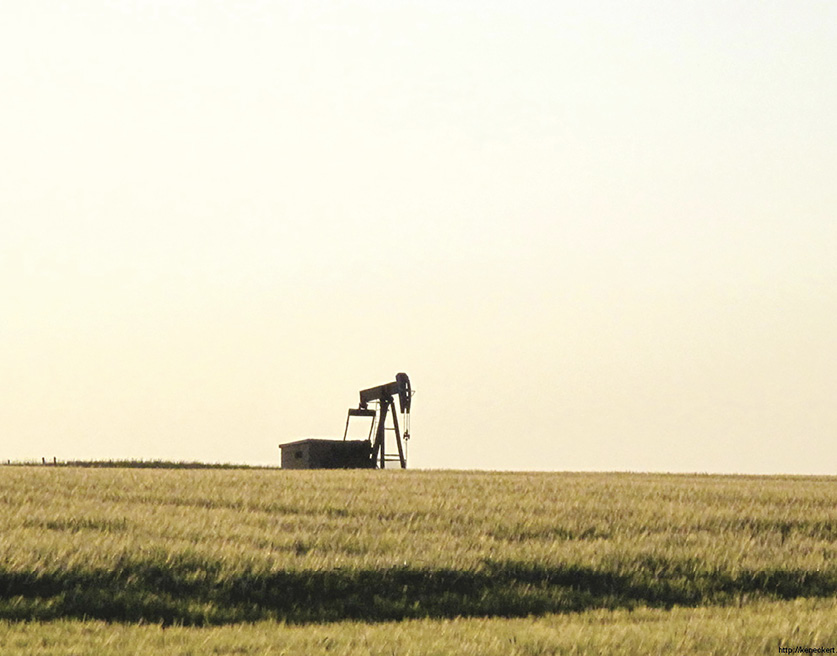
Oil pump near Ponoka, Alta., in August 2010. Photo courtesy of Ken Eckert /
Wikimedia Commons
“Syncrude, in general, actually does really well when it comes to the sexism,” says Cormier. “It was a lot of the smaller companies that weren’t so great with it.”
For Cormier, the pressure to demonstrate her worthiness of the job led her to think outside the box and find alternative solutions to problems.
“But the hardest part, too, was, naturally, I’m just not as strong as the guys, so I had to work smarter, not harder,” she says.
Cormier is far from the only tradeswoman to have experienced sexism in the field. Electrical and instrumentation coordinator planner Jennifer Sweeney says the gender-based aggression she faced was more direct.
When she first started her career as an apprentice, Sweeney had a hard time completing hands-on work, as she was often told by male coworkers that she was “not allowed to do that because it wasn’t a woman’s work.”
In her time as an electrical coordinator, Sweeney says sometimes “your passion gets held against you,” and in other cases is interpreted as aggression.
She says a recent example of this situation occurred when she questioned how her male colleagues were structuring a meeting.
“So then I got told that I was very smart, and I could do anything, but I could come off abrasive sometimes,” says Sweeney.
Although sexism and gender discrimination remain prevalent issues in the extraction industry and other blue-collar fields, large corporations such as Suncor and Canadian Natural Resources Limited (CNRL) are setting goals to increase the number of female leadership positions.
For example, Suncor’s board of directors has a goal of 30 per cent gender diversity for males and females, and highlights that the current number of women on the board is 36 per cent. Similarly, CNRL believes in a minimum female board composition of 40 per cent.
Many of these companies are dedicating time and resources to addressing these issues at a corporate level, often with assistance from programs such as Employers of Choice run by Women Building Futures (WBF).
Tara Hoffmeier, the manager of the WBF’s workforce inclusion programs, says gender roles are still “very deeply ingrained” in the trades and transportation industry.
“Our role is to really kind of help folks understand that these deeply held kind of thoughts and ideas of who belongs where are outdated, and we really want folks to see the value of diversifying our workforce,” says Hoffmeier.
Through organisations such as this, women are provided support for the challenges that come with entering a male-dominated field, while corporations, through paid memberships, can access resources and courses necessary for building accessible, safe working conditions for new female trade graduates.
According to Hoffmeier, this process would not be sustained if not for the incoming tradeswomen and the companies participating in the programs.
“We’re looking at creating systemic change, and that really takes everybody in the industry to do,” she says.