
Hidden cost of the game: Concussions and CTE in hockey
Naomi Campbell, Staff Writer
In every sport, there is some form of physicality, even if it isn’t aired publicly or noticed as intensely as football. One thing that can come from this physical aspect is Chronic Traumatic Encephalopathy, otherwise known as CTE. One sport that you don’t hear about often, relating to CTE, is hockey. Hockey is the third major sport, after American football and rugby, to show a dose-response relationship between years of play and CTE risk.
After talking to former Mount Royal University Men’s Hockey Captain, Connor Blake, his story of his concussion shed light on how diligent players have to be in keeping themselves healthy, and their heads up while on the ice, because anything can happen, even when you least expect it.
Connor Blake is a 26-year-old defenceman from Calgary. He grew up playing hockey from a young age, projecting his career as a junior player for the Grande Prairie Storm of the Alberta Junior Hockey League (AJHL). From there, he was recruited to play for the Mount Royal University Cougars, using up his full five years of eligibility, earning himself the captain patch in his final season and becoming a Cougars legend.
Blake was fortunate enough to sign a professional contract at the end of his university career, for the Idaho Steelheads, playing only three official games there before moving on to the Adirondack Thunder, where he played thirteen games. In 2024-2025, Blake moved to France, and joined the Ligue Magnus, playing for the Anglet. He played 35 regular-season games, earning himself 12 points. As of 2025-2026, Blake is currently in Germany playing for the ECDC Memingan Indians in the Germany3 league.
Connor Blake has always been a smaller defenceman, standing at five foot nine, which puts him below the current average height. He started out as a forward before being swapped over to the blue line in his first year at MRU. Yet that has not stopped him from playing just as physically as the bigger players he skates alongside on the blue line. Blake has stayed a healthy player over his whole hockey tenure, up until his season in France.
Two weeks before suffering a concussion, Blake started showing signs of what he and his captain could call a minor stroke. After a game, the right side of his face and right hand went numb. It eventually ended up going away, after taking a week off, and getting an MRI and cardiologist, everything came back completely normal.
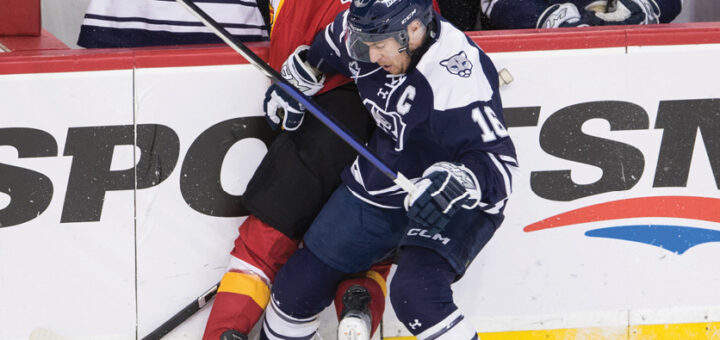
After being put back in the lineup, Blake was hit into the boards and ended up blacking out on the ice. He was taken to the hospital, where he had more scans done, which in turn put him out for six to eight weeks.
Blake talked about how he’s been hit way harder in terms of physicality-wise over his career, bringing concerns regarding why he ended up cooped up in his apartment for four months despite this being one of the smaller hits he’s received.
“There were some alarms with it because I have no recollection of what happened that day,” Blake said. “I saw the video of the hit; it’s not a big hit by any means at all. I’ve been hit way harder and been totally fine.”
When a player gets diagnosed with a concussion, teams will have baseline testing done at the beginning of the season, so that they can look back on it in terms of progress to get them back in the lineup. During his time at MRU, the Cougars did baseline testing every year, so that they could be cleared for activity. This followed along when he moved to the East Coast Hockey League (ECHL). That wasn’t the standard in Europe, as they do not do any baseline testing, so his progress was tracked solely on tests and trusting that Blake was telling the truth about his symptoms.
“Unfortunately in France, we didn’t really have any baseline testing. In fact, I did a baseline concussion test after I got diagnosed with my concussion.” Blake said. “That’s also something not that because I’ve played professionally, I can’t go back to the school program. So that’s something I have to advocate for myself.”
The mental and physical toll that a player goes through is another issue when talking about concussions. For Connor Blake, the biggest hill to climb was that mental battle.
“Being confined to my house and only going for walks when I was feeling ok, really took a toll. I wanted to see the guys and just chat,” Blake said. “So obviously, the brain health wasn’t great, and it did get better, but my mental health was struggling too.”
For being such an active person, having to sit at home in silence, while staying off his phone, and having little to no human interaction took the biggest toll.
“I couldn’t feed off of my teammates…Having that taken away for over a month, that was the hardest part, [I] was truly just doing nothing,” said Blake.
With concussions, the progression back to health is different for every player. For Blake, the unknown was frustrating.
“Not knowing when I wake up, how the day is going to go for me. Sometimes I’d start well and would finish not great and then other times I would wake up with a headache and have to start protocol all over again.” Blake explains. “I even got to the point where I got on the ice, and the helmet pressure was giving me a headache, so again, I’d have to start back at the beginning.
Blake is back on the ice officially and has kept healthy ever since his incident. Coming from Calgary, he has also coached at the SDR Academy. Blake is a huge advocate for teaching young players how to hit and take hits properly, especially with how fast the game of hockey is evolving. Over his career of playing minor and junior hockey, he noticed that players aren’t always taught to hit, and that the worst injuries can come from hesitating on checks and hits.
“I preach every single day at practice to keep your head up, not only up to see the plays, but for spatial awareness to see where the danger is coming from, to know how much time you have,” Blake said. “As you get older, hockey keeps getting faster, the hits get harder, and you need to keep your head up, and that’s number one on how to protect yourself.”
Much about CTE is still unknown, as diagnoses only come after death. A study done at the Boston University CTE Center showed that out of 77 deceased male hockey players, 96 per cent of professional players had CTE pathology, 46 per cent of college, junior and semi-professional players and 10 per cent of youth and high school players. Whether they played as an enforcer or not, there is a high likelihood that the repeated checks and hits to the boards or ice can cause CTE the longer a player stays in the sport.