
Pastafarianism: Why Canadians are getting a taste of the new religion
Julia Finot, Staff Writer
A deity made of noodles and meatballs may sound like a joke, but for followers of the Flying Spaghetti Monster, it represents something deeper. Pastafarianism, the religion, encourages curiosity, skepticism, and healthy humour while challenging traditional norms.
What began as an argument against American high school education quickly captured global attention and changed the way society views religion.
In 2005, Oregon State physics graduate Bobby Henderson wrote a letter to the Kansas Board of Education expressing his disapproval of teaching intelligent design theories in high school evolution classes.
He argued that if intelligent design were included in the curriculum, they would have to consider teaching another theory: that the universe was created by a Flying Spaghetti Monster.
Henderson did not receive a response from the board, so he posted his letter online, which quickly gained traction and went viral.
The official creation of Pastafarianism occurred when Henderson wrote The Gospel of the Flying Spaghetti Monster one year later, a handbook for the religion that outlines its commandments, comparable to an avant-garde version of the Bible.
By the (cook)book
Pastafarians value critical thinking, kindness, personal freedom, as well as humour and humility. They see that critical thinking allows for the separation of religious belief from government policy.
Kindness and personal freedom tie into the Gospels’ Eight I’d Really Rather You Didn’ts, also known as the Eight Condiments. These phrases are suggestions for Pastafarians, urging followers to treat people with kindness, avoid judgment, and responsibly enjoy life.
Humour and humility encourage followers to laugh, as laughter is a healthy way to respond to the mystery of the universe.
The book encourages Pastafarians to wear religious attire. Pirates are believed to be the original Pastafarians, so the Gospel encourages believers to wear traditional pirate dressware as a symbol of faith.
In modern day, Pastafarians wear this attire at formal events, most commonly seen at weddings.
Another piece of regalia commonly associated with Pastafarians is their wearing of colanders. Wearing a pasta strainer on their head is meant to honour the Flying Spaghetti Monster and advocate for equal religious representation.
Spaghetti and metaphysics
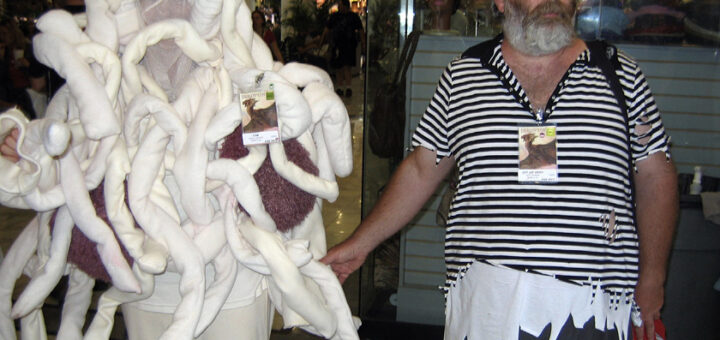
The entire belief system of Pastafarians revolves around the Flying Spaghetti Monster. It is the central embodiment of the faith, the deity of the Pastafarians, and exists as a complex carbohydrate-based entity consisting of willowy eyestalks, two large meatballs, and a multitude of noodly appendages.
The symbol is known among its followers as a kind and benevolent figure, but on a deeper level, it is also intellectual, bringing a sense of spiritual humility and humour to belief.
Followers posit that it created everything in existence, calling it the single reason gravity exists because it holds everything together with its long noodles. Additionally, they believe it is the sole inspiration for the invention of the oscillating sprinkler.
They say that the spaghetti monster is a reminder to everyone that no one has perfect knowledge of the universe, and that curiosity, skepticism, and kindness are more valuable than certainty.
Ahoy, pyrate!
Dread Pyrate Higgs is the captain and ministeroni of the Church of the Flying Spaghetti Monster of British Columbia.
His involvement in the church began back in 2016 after a conversation with a self-proclaimed Pastafarian. Higgs felt that Pastafarian beliefs aligned with his own values and views, inspiring him to commit to the religion.
He said he has always been attracted to philosophy, theology and spirituality, and he has explored many faiths, but none seemed to fit his needs.

Captain and Ministeroni of the Church of the Flying Spaghetti Monster of British
Columbia, Dread Pyrate Higgs. Photo courtesy of Dread Pyrate Higgs
“Pastafarian allowed for belief and spirituality that was flexible, like an al dente noodle, that encouraged humility in that we ought not to take ourselves too seriously in thinking we have the one true answer to existence,” Higgs wrote in an email statement to The Reflector.
His faith encourages questioning, creativity, and community, allowing him to reflect seriously on philosophy and ethics while also enjoying freedom of expression.
“My favourite part is that the religion invites people to combine thoughtfulness with joy and to consider modifying the Cartesian maxim: ‘Cogito, ergo sum’ to ‘Dubito, ergo sum’,” Higgs explained.
Being a Pastafarian in Canada has had some mixed results. While the majority of the community has been accepting of Higgs, the federal government has looked unfavourably on the faith.
“In practice, they have demonstrated a desire to hold up traditional religions as protected institutions, rather than a champion of ideals enshrined under the Canadian Charter of Rights and Freedoms,” wrote Higgs.
While Pastafarianism began as a satirical response to debate about science and religion, its followers say the movement carries a message beyond pasta-loving pirates. Believers like Higgs see the Flying Spaghetti Monster as a reminder that humility and curiosity should guide people’s understanding of the world.
Whether seen as satire, philosophy or faith, Pastafarians continue to spark conversations about belief, freedom, and the role of religion in modern society.