
Ball comes to life at Calgarian Jurassic Park after 46-year hiatus
Zafir Nagji, Sports Editor
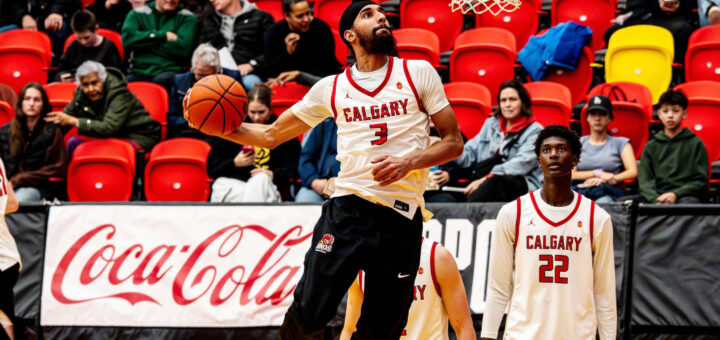
For the first time in nearly 50 years, the University of Calgary Dinos will host this year’s U SPORTS National Basketball Championship Final 8 Tournament from March 6-8. The best university players on the best university basketball teams from across Canada are set to convene in the Blue Sky City for a winner-takes-all three-day tournament for nationally recognised bragging rights, a chance to be scouted by professional teams and the prestigious W.P. McGee trophy.
The battlegrounds
The University of Calgary hasn’t hosted this tournament since 1980, in which the University of Victoria Vikes claimed a 73-65 win over the Brandon University Bobcats to win a national title. That happened seven years before the Jack Simpson Gymnasium, where this year’s tournament will be played, was even opened, making this the gym’s first-ever national tournament.
Most of the tournaments since then have been hosted by Réseau du sport étudiant du Québec (RSEQ), Ontario University Athletics (OUA) and Atlantic University Sports (OUS) in cities like Quebec City, Ottawa and Halifax, respectively. Over the same period, Canada West (CW) universities have hosted three national tournaments, with the University of British Columbia hosting two (2016, 2025) and the University of Alberta hosting one (2022).
The rules of engagement
As the name suggests, eight university teams from across the country will compete in the tournament. As hosts, the Dinos are guaranteed a tournament berth, as are the champions of all four conferences. One other medalist from the CW and OUA conferences will also receive a tournament berth, with the eighth and final tournament berth going to a team selected by a U SPORTS-appointed committee based on factors such as final regular-season record, strength of schedule and eight other criteria.
The teams are then seeded one through eight by the U SPORTS office to set up the quarterfinal matchups and divided into two clusters to determine their path to the final. The first-seeded team plays the eighth seed, second plays seventh, third plays sixth, and fourth plays fifth. The teams compete within their respective clusters to earn their spot in the final game, where they play the winning team from the opposing cluster for the gold and silver medals. The losing teams from the semi-finals then compete for third place and a bronze medal.
The tournament begins with quarterfinals on March 6, continues with semi-finals on March 7 and concludes with the highly anticipated final on March 8. Each round is a single-game elimination, similar to the NCAA’s March Madness college basketball tournament.
That format gives every team a chance to win, as it takes winning just three games in a row to take home a national title, and that gives every player more reason to leave everything they have on Jack Simpson Gymnasium’s hardwood.
Canada West’s revenge
Canada’s eastern half has long reigned as the country’s basketball mecca, but the western half has since made up some ground. Team Alberta swept the men’s and women’s basketball gold medals at last year’s Canada Summer Games, and five of the last nine U SPORTS National Tournament Championship final games featured a CW team in the final game. The Victoria Vikes won last year’s national championship, the Saskatchewan Huskies made a final appearance in 2022, losing to the Carleton Ravens, and the Calgary Dinos made three final appearances, including their 2018 national championship victory over the Ryerson Rams.
Three of the universities ranked in the top 10 of the latest U SPORTS Men’s Basketball Rankings play in CW, with the Victoria Vikes second, the Winnipeg Wesmen third, and the UBC Thunderbirds fifth. Last year’s U SPORTS National Player of the Year also came from a CW team: the University of Calgary Dinos’ Nate Petrone, who now plays professionally in Germany.
When it came to basketball, the East would historically feast, but recent years have shown the West making a strong case to be the best, and with Calgary playing host to this year’s tournament, the chances are as high as they could be for a CW team to win it all.
Formidable foes
As hosts, the UofC Dinos were guaranteed a spot in the tournament, but enter as the eighth and lowest seed after their early CW playoff elimination. As a result, they match up against the CW Championship-winning and highest-seeded team in the tournament, the UVIC Vikes.
With the third-most free throws made per game, the Dinos will look to turn up their aggression and keep the game close to force an upset. Victoria is no slouch, though, and will force the Dinos to burn energy on defence as the Vikes posted a U SPORTS-topping offensive efficiency of 1.09 points per possession.
In the same cluster, the AUS Championship-winning Acadia Axemen are the tournament’s biggest underdog and hold the fifth seed in the tournament. They match up against the Bishop’s Gaiters, who earned the wild-card berth after losing in the RSEQ final to Laval.
The Axemen posted the second-most assists per game (19.2) and the eighth-best three-point percentage in the country (33.5), but will have to up their volume of long-ball attempts to counter Bishop’s 1.049 points per possession — the fifth most efficient offence in the league.
One spot above them are the UBC Thunderbirds, who hosted last year’s Final 8 tournament and are the definition of a sleeping giant. They take on one of the tournament’s heavy favourites, the Toronto Metropolitan University (TMU) Bold, in what could be the most exciting and closely contested first-round matchup.
The Bold won the OUA Championship with their U SPORTS-best three-point defence, allowing opponents to shoot just 24.5 per cent from downtown. That being said, UBC ranked fourth in the country in points per game (86.6) despite ranking 24th in three-point attempts (26.1).
Occupying the sixth seed, the Carleton Ravens have the most U SPORTS titles of any Canadian university, having won 17, eight more than second-placed Victoria. After losing in a closely contested OUA Final to TMU, they face the RSEQ Championship-winning Laval Rouge et Or to round out the other cluster.
Both teams rely on their interior presence heavily, as Carleton ranked first in offensive rebounds per game (16.3) and total rebounds per game (44.7) while holding opponents to the fewest offensive rebounds per game (7.5) and total rebounds per game (29.8) in the country. Laval, meanwhile, hold their opponents to the fewest defensive rebounds per game (30.6) and average the fourth-most blocks per game (4.4) in U SPORTS.
Predicting the unpredictable
Forecasting a champion in a single-game elimination tournament like this is nearly impossible at best, but the numbers can help make for some well-informed guesses.
In the first cluster, Victoria is heavily favoured to beat Calgary, which would match them up against the winner of Acadia and Bishop’s. Acadia’s statistical proficiency just doesn’t stack up against Bishop’s, who also play in a tougher conference, setting up a matchup between the Vikes and Gaiters, which Victoria should be able to win.
In the second cluster, UBC and TMU are, at best, a coin toss, but for the sake of supporting the CW, I’m picking the Thunderbirds to advance. Carleton should be able to handle business over Laval, and against UBC, the Ravens’ championship experience and voracious interior defence is likely to prevail.
That sets up a cross-country matchup between the Victoria Vikes and Carleton Ravens for the U SPORTS National Championship. Both teams are incredibly close in a variety of statistics, but as a CW homer, I’m going with the Victoria Vikes to win back-to-back W.P. McGee trophies.
Tickets for the tournament do not follow the same process as traditional tickets, but are still available on the U SPORTS website. With every team just needing three consecutive wins to claim a national championship, all eight squads will be looking to cut the nets at Jack Simpson Gymnasium, especially the hometown Dinos.


