How a prairie-born Pride education group is going national
Sarah Palmer, Features Editor
Eight years ago and 1,300 kilometres away, rainbow colours drenched downtown Winnipeg as Manitobans commemorated the 30th annual Pride parade. The theme—Resurgence: Taking Back Space—highlighted how far the queer community had come since 1987.
That year, sexual orientation was officially added as a protected ground under the Manitoba Human Rights Code, marking a pivotal moment in the province’s history. Honouring the milestone, Winnipeggers traded protesting for parading and took to the streets.
“There was a celebratory march and gathering in front of our Manitoba legislature building in ‘87,” says Pride Winnipeg’s former president, Jonathan Niemczak. “That was our first Pride, and we’ve been doing Pride ever since.”
Though the event took place before his time, it has captivated Niemczak ever since he learned about it. In the 2010s, when opening Pride Winnipeg meetings, he says that he would often retell it as a powerful reminder of the organisation’s roots.
“I found that story really interesting, but a lot of folks weren’t aware of that,” says Niemczak. “In fact, the organizers of the Pride’s themselves didn’t really know their own history in terms of how Pride got started in their community.”
It was then that Niemczak noticed how the history of Pride, not just in Manitoba but across Canada, was largely preserved anecdotally, often found in slim volumes of books and journals. He says this inspired him to help bridge the gap in queer history resources.
Turning Pride documentation dreams into reality
In 2014, Niemczak pitched the idea to colleagues and community members attending the Fierté Canada Pride conference, which received positive support. Four years later, he stepped down from his role at Pride Winnipeg to establish the Canadian Pride and Historical Society (CPHS).
The organization investigates and archives past Pride activity in municipalities across the nation. With upwards of 50 volunteers, Niemczak says they focus on conducting region-specific, online research.
“We use that to start piecing together a sort of puzzle,” he says. “We’re looking at, ultimately, how did Pride form in that community? What led to the formation of Pride? Was there an event that sparked it?”
Having initially opened in Manitoba in 2021, the CPHS soon after launched operations in Alberta, Saskatchewan, and British Columbia. Eventually, Niemczak says that they will expand to Eastern Canada, but that the West remains a priority.
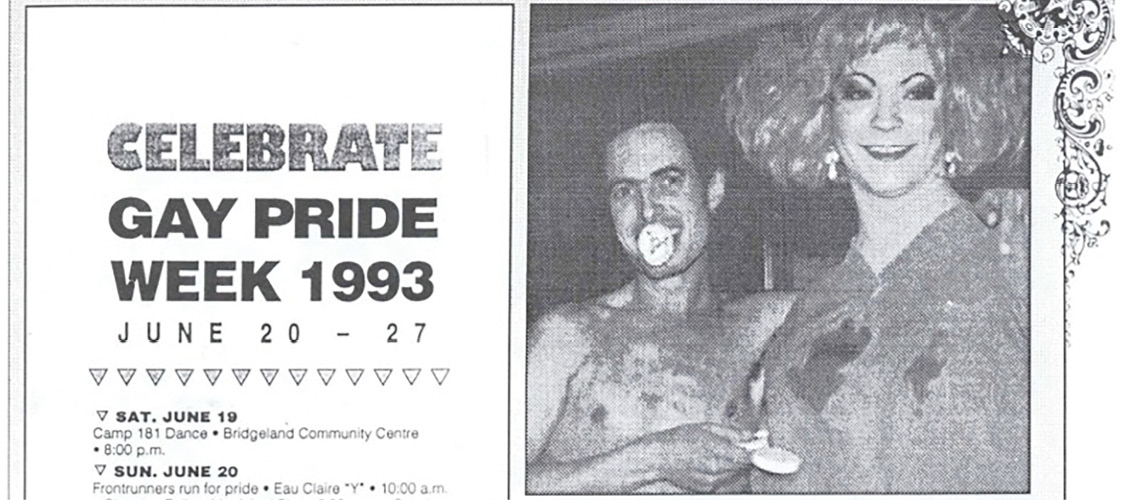
Poster from 1993 advertises celebrating Calgary’s Gay Pride Week. Photo courtesy of Canadian Pride Historical
Society
Western anti-queer rhetoric warrants attention, says Niemczak
When the CPHS ventured to Alberta, Niemczak says that they looked into roughly 1,500 data points across 20 different communities. He says that places like Medicine Hat and Fort McMurray have a relatively new Pride history, but that Calgary and Edmonton have a longer, more bitter paper trail.
“In the larger cities, we tend to see more of that anti-Pride movement, versus in the smaller cities and towns,” says Niemczak.
No matter the location, the CPHS provides the school boards attached to the places that they research with lesson plans. Niemczak says queer history is virtually non-existent in the country’s curriculum.
“When we look at social study curricula across Canada, they do tend to cover a lot of the major rights movements,” he says. “But the 2SLGBTQIA+ movement is absent.”
In the Western provinces, specifically, Niemczak says that there has been a rise in hatred against the queer community. For Alberta and Saskatchewan, he says that recent restrictions on gender expression and school content for young students have only catalysed this.
“When we look at government legislation and where governments are putting priority, they’re really feeding into this parental rights movement piece that we’ve kind of seen coming out of the U.S., and they’re just hitching their bandwagon to it,” he says.
Niemczak says that a quality education covers the nation’s history in full, and that since virtually no textbook touches on Canadian queerness, the CPHS’s online resources—organised by grade level and learning outcome—seek to remedy this.
“Our community has suffered greatly at the hands of government, as with other equity groups, and our story should be one that is taught in the classroom,” he says. “This is the way that you ultimately get at people’s ignorance, is you teach them.”