
Yearn for the Past: The Digital Camera
Mia Smith, Web Editor
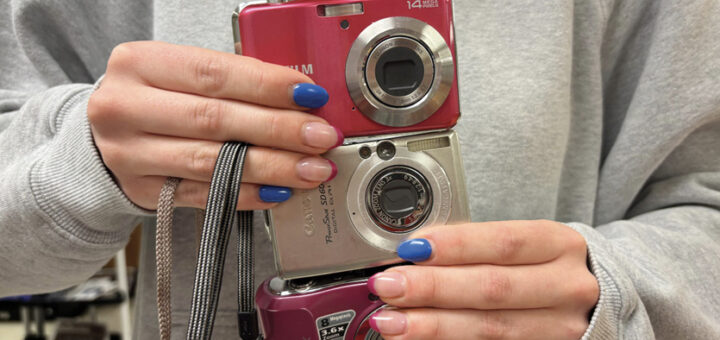
Over the past few years, the world has seen an unexpected, yet oddly familiar blast from the past—the resurgence of compact digital cameras. While this could be because of their vintage appearance or nostalgic vibe, the main question to be asked is: what is the cause for this recurrence?
The retro trend started with the revival of disposable cameras, such as the classic Kodak Fun Saver and the FujiFilm QuickSnap Flash cameras. These cameras added an element of surprise to an evening, with every film roll being a mini time capsule.
The shift away from these disposable cameras, however, happened when cash-strapped college students began to wonder why they are spending $30 for 20 pictures?
In a world where anyone with a phone can be a shutterbug, youth are now turning their backs to their most accessible option, the phones themselves. Instead, kids are scouring the internet on platforms like Facebook Marketplace and eBay to get their fill of nostalgia.
With their compact size and easy to understand settings, anyone can use a digital camera. Unless you’re over the age of 25, you probably haven’t seen a digital camera in years. Go to any bar or pub around town, however, and I bet you will see multiple being used by Y2K enthusiasts.
This fad stems from the age old saying ‘what goes around comes around.’ It remains that people have long been fascinated by the age that comes before them. From skinny jeans to maxi skirts, every time something goes out of style, it inevitably comes back in—digital cameras are no exception.
There is also something to be said about the elite and their ability to influence the younger generations. Loud names like Bella Hadid, Alix Earle, and Brie Larson have been spotted out in public with the early 2000’s staple in their right hand.
Youth today are entranced by all things vintage, from vinyl records to boots with the fur. Call it retro-enthusiasm or modern-rejection, our generation is the pinnacle of ‘I was born in the wrong generation.’
In a world flooded by 4K HD photoshoots, the low-fidelity photos from digicams add a ‘nonchalant’ vibe to any photo, giving it a different look from the millions of other Instagram posts that are going out every day. In an era of ultra-high-definition everything, there’s something pulling about the grainy, low-resolution charm of digital cameras—it almost feels counterintuitive, yet people can’t get enough.
There is also a shred of relaxation that comes with putting your phone down and letting your camera do the work. Digital cameras give you the opportunity to not worry about push notifications disrupting the moment.
Plus, they make a great story later.
Digital cameras create a timeless quality that you cannot fully dive into until you decide to download the images. This produces not only a feeling of nostalgia from the times that lived us before, but an element of surprise to an otherwise dull time of life.
The digital camera is a glimpse into the mind. The world is in a constant state of change, and youth yearn for a state of stableness.
In an age of hyper-curated content and constant digital noise, youth are craving real moments that feel raw, unfiltered, and emotionally honest.
These photos are perfectly distorted. With every picture you take, a little piece of the past is ingrained in the present.
“Those images make us feel nostalgic. And I think people are chasing that,” said freelance reporter Elizabeth Gulino, who covers lifestyle and internet trends, in an NPR interview. “I think people are feeling really nostalgic for the era, like the early 2000s, when everyone would bring their digital cameras to the club or, like, to a family party and stuff and take those photos. And those images make us feel nostalgic, and I think people are chasing that.”
Recycling has never looked this cool. Digging out an old camera from the basement and taking it for a night on the town? That’s a whole new vibe.
Just like clothing, photography has trends too. Black and white, high saturation, and now vintage digital. While millennials planted the seed, Generation Z are the ones watering the plant.
Once a technological breakthrough, photography is now as accessible as the click of a button. True photography means slowing down, therefore, Generation Z’s pull to digital cameras is linked directly to their desire for emotion and human experience.
It is a quiet rebellion against the rampage that is modern technology.
Ultimately, the pocket sized commodity is a reflection of people’s yearning for simplicity, which manifests in moments that are instantly shared but slowly revealed.


