A look at performative male contests
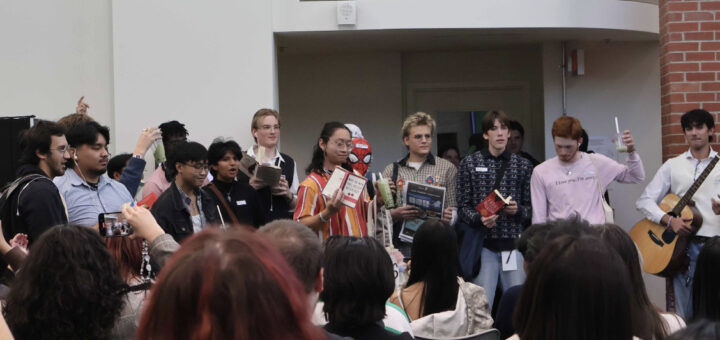
Excitement and anticipation fill the room as people take their seats, while others mill off to the side. No matter where they are, they all lean forward to catch a glimpse of the boys to come.
It’s like a concert. From the outside, you would never guess that these hundreds of people were waiting for Mount Royal University’s (MRU) performative male lookalike contest, not until you witness tampons and birth control thrown into a crowd, pads on men’s heads and the word feminism thrown into every sentence.
This last year, the image of a man wielding matchas, labubus, feminist literature and indie artists has been ridiculed on the internet for being a caricature, a ploy by men to appeal to women’s values without any sincerity.
It began with a Timothée Chalamet lookalike contest in New York City in late 2024. Since then, it has only grown in scale and scope, donning the faces of everything from celebrities to fictional characters to internet archetypes —the performative male.
What’s the draw?
Besides the trends and outrageous personas, why are young adults across the world flocking to organise and participate in these lookalike contests? Particularly, why are Calgarians going to these events?
Between the University of Calgary and MRU, fall 2025 saw several performative male lookalike contests, as did many other Canadian universities.
But what was in it for students? Prince Manzano, one of 18 contestants at MRU’s event in October 2025, says his reason for competing was to put himself out there.
“I thought that it’s my last year, let’s make a memorable impact,” says Manzano.
Taimur Ashraf, the winner of MRU’s contest, says his motivations were similar. Ashraf says the contest was a great way to make friends.
The tie-breaker on Ashraf’s win was his cover of Creep by Radiohead. He sang in front of a crowd of his peers, guitar in hand and stricken with fear, and watched as they responded in earnest.
“The people in the front row, while I was singing, immediately started singing along with me,” he says. “There were people over there with flashlights on their phones, and they were waving the phones around. It was very magical.”
Everyone from the contestants, to the audience members, to the judges believed Ashraf would win—he was the only one who brought a guitar. For Ashraf, winning the contest was surprising and gratifying. He says the experience taught him that his voice has value.
As for Manzano, his story is not so symbolic, but he did manage to make the memorable impact he was looking for. With an earnest performance, a good singing voice, and a charming disposition, he won second place.
He says the people he met—including contestants and the audience members—are what he treasures most from the experience.
“I felt that I got to meet new people,” says Manzano. “Seeing people that are in the same mindset of let’s have a fun thing, let’s be chalant. Seeing other people like that made me feel like this is the group that I want to be with as I move forward.”
Many of the contestants share these viewpoints. The contest was a silly idea, a TikTok or Instagram trend brought to life, but it inspired spontaneous responses. For the contestants of MRU’s performative male contest, the experience connected them with their peers.
Audience members voiced a similar feeling. While sitting through the two-hour pageant, cheering for their favourite contestants and anxiously awaiting the winners, they turned their mockery of the trend into sincere engagement with one another.
Maybe that’s what Calgary’s youth have flocked to in these lookalike contests—sincerity amid the irony, and genuineness amid the silly.
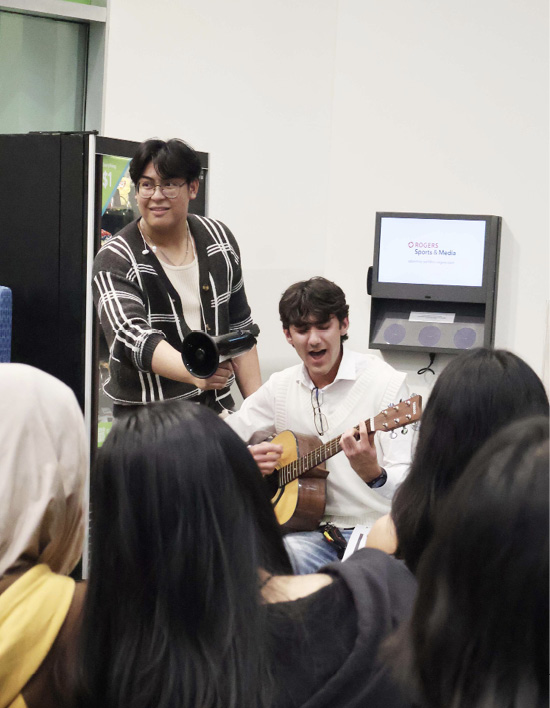
Winner of MRU’s performative male contest, Tamir
Ashraf, sings Radiohead’s “Creep” at the Wyckham
House food court. Photo by Nadoo Abaagu
Is it all a performance?
While lookalike contests are inherently performative, Manzano and Ashraf say there is some sincerity to the shows they put on.
“The outfits that I wear myself and the things that I do, kind of align with what people consider performative,” says Ashraf. “So it’s kind of funny to me because my friends were just saying, ‘this is literally what you wear every day.’”
Manzano says playing the performative male is ironic.
“This trend allowed us to ironically like our stuff,” says Manzano. “We do it for the joke, but I feel like most people use the joke and are like, ‘Okay, I actually like this.’”
Lookalike contests present a heightened version of the performative male, complete with every foolish stereotype, ready for audiences’ mocking. But they are ultimately contests full of contradictions—archetype versus reality, irony versus sincerity.
The performative male is ridiculed, but he represents a broader cultural acceptance of men who step outside the neat boxes of masculinity or femininity. Men who pick and choose a little from both.
“I feel that that trend actually benefited male masculinity,” says Manzano. “I feel like having trends like this, making fun of what is masculine, allows more men to be okay with liking feminine interests.”