PROFILE: Virginia Bruneau
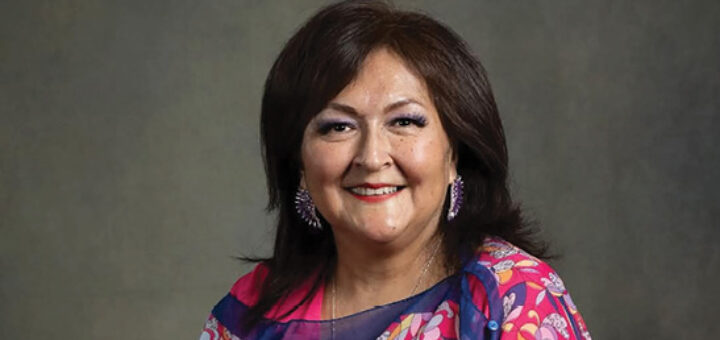
Emma Marshall, Arts Editor |
“We used to have a light outside. It was a post that lit up the whole backyard, but because money was so tight, they had to cut it off.”
Virginia Bruneau remembers that moment with clarity—the light symbolizing a glimmer of hope that was slowly dimming. Yet, even in the darkest of times, she learned from her father the power of love, growth, and resilience.
Now, as an adult and mother, Bruneau is determined to bring light back to her community in a different way—by fighting for clean water infrastructure on First Nations reserves.
Bruneau, a member of Cold Lake First Nations, is on a mission to ensure that future generations don’t have to grow up without basic necessities.
Her work addressing water and housing infrastructure on First Nations reserves is just one facet of her larger mission to empower children and inspire them to see their potential.
Her story is one of resilience, inspired by the struggles and triumphs of her own family.
“Growing up on the reserve, we had a very well-kept home,” Bruneau recalls, reflecting on a childhood that, despite challenges, was filled with love and routine.
Her father, Greg Jacko, was a key figure in the community, working tirelessly to improve the living conditions of those around him.
His most notable achievement was his role in a peaceful strike/sit-in that resulted in the building of new schools on Cold Lake and surrounding reserves in the early ’70s. It was a moment that left an indelible mark on Bruneau, sparking a fire in her to push for change.
Now, with her upcoming book, We Were Much More Than Porridge, set to be published this October, Bruneau is using her voice to inspire the next generation to overcome adversity and believe in their worth.
“You have to tell children they are important, and what they bring to the world is important,” she says.
Through her personal story, her activism, and her unwavering commitment to her community, Bruneau is lighting the way for others—just as her father once did.
“We still don’t have running water,” Bruneau reflects. “That’s how they set it up. It’s a hand to mouth mentality that they put First Nations in.”
This statement is not just a lament but a call to action, a reason why she founded Tu-Kanatan Inc.
“Tu means water in Dene, Kanatan means clean and pure in Cree,” she explains, underscoring her mission to provide essential services to First Nations reserves that have been overlooked for far too long.
Dene is the language spoken by Cold Lake First Nations, and Cree is the language her husband’s family speaks. She used both languages in building her business to represent the continued support of the people around her.
Her drive stems not just from the lack of basic needs like clean water but from a deeper passion to uplift the youth of her community and inspire them to overcome the systemic barriers that have long held them back.
Bruneau’s journey wasn’t without its struggles. She became a Christian in 1983 and faced personal challenges, including navigating difficult relationships with law enforcement and her children.
But, through it all, she was determined to forge her own path.
Tu-Kanatan Inc. is currently on pause after the passing of her business partner, but Bruneau is pursuing other methods of advocacy with the same goal in mind.
Spearheading her own craft business, Freedom Earrings by Ginny, Bruneau makes delicate jewelry and wreaths by hand. She uses the money from this business to support herself and her family through the writing of her book, which is now in the final stages of publication.
The book is a reflection of Bruneau’s own growth and healing. Written over the last several years, it delves into her experiences, her family’s history, and the larger struggles of Indigenous communities.
“My father used to make porridge for us every morning of our life, and what [my parents] went through in residential schools was totally contrary,” says Bruneau. “They made them porridge, alright, but they didn’t put any sugar. They didn’t give them any bread, just a plop of porridge and that was it.”
“In contrast, my father made us porridge every morning and would make sure to put sugar in there. He would make toast for us. He would get up early to get the house warm for us, and he would make porridge for us,” she recalls with a smile.
This image of her father making porridge and caring for his children deeply impacted Bruneau, leading her to write her upcoming book, We Were Much More Than Porridge. She hopes the book will inspire children, particularly on First Nations reserves, to understand their worth and potential.
“You have to tell children they are important, and what they bring to the world is important,” she affirms.
In her years of activism, Bruneau has faced opposition, and at times, felt the weight of a system that appears indifferent to the struggles of First Nations communities. But her experience has also taught her the power of compassion.
“It’s so important not to live your life by yourself, thinking of your own needs, but thinking of the needs of others,” she says. “That is so very valuable.”
Bruneau’s story is one of persistence, of never giving up on her people or her mission.
“I feel like [my work] is going to influence a lot of children for the better,” she says. “Because if a woman like myself can go through the challenges that I did and still come out relatively happy, they can do it too.”
In a world where many Indigenous communities face systemic neglect, Virginia Bruneau’s voice stands as a beacon of hope.
In the face of adversity, Bruneau is showing her community that they are more than just survivors—they are champions of change.